Tuesday, 27 October 2020

Three women of Ryburgh: a memory of lives in a Norfolk landscape

It begins with a story of families. All local Norfolk families, intermarried enough times to make them, in reality, just one family with a series of different names. Cousin marries cousin, marries cousin, marries cousin, and in a few generations everyone is a cousin, an uncle, or an aunt - and possibly has more digits than is totally normal, even for Norfolk. Marriage within the family keeps the bonds and ties of land strong. Joins up small manors to make greater manors, greater manors to make great estates, and over the generations dynasties are born, and prosper. Unless of course things go wrong. Unless fate looks unkindly upon your house. Unless the hard work of generations is all undone, and instead of being blessed with strong and healthy sons, you have nothing but daughters...

So the traditional narrative goes. A medieval noble family without a male heir was one to be pitied. Daughters divide up manors and lands, lead to the death of family names, and the undoing of generation upon generation of careful dynastic construction. Daughters were, through no fault of their own, simply the second best option.

The Walkfayre family had played their part in the county life of Norfolk for generations. They weren't the richest, or the best known, but they were a well off and respectable county family who could draw upon the resources of half a dozen manors in north-west Norfolk. By the middle of the fourteenth century they could consider that they had done well for themselves in recent generations. They had expanded their holdings, and in the years after the Black Death had capitalised upon a fluid land market, putting themselves in a position that could be described as comfortable. In another few generations, and with favourable marriages, they looked set to become a formidable local dynasty. And then disaster struck, and all was seemingly bought crashing down in a single generation. The family produced no male heir, and not one, but two, daughters - joint heiresses to the whole family.

In the normal course of medieval events that would have really been the last that was heard of the heirs of the Walkfayre family. The daughters would have been married off, undoubtedly advantageous matches due to their likely inheritance, and they and their husbands would have continued the task of dynasty building, albeit in his name rather than hers. However, the Walkfayre women were made of sterner stuff. They had an iron in their personality that wasn't so easily bent to another's will.

The river Wensum at Great Ryburgh

Joan Walkfayre did indeed marry well. Her new husband was already well known to her, being distantly related, and living only a few miles from her own manor of Wood Hall in Ryburgh Parva (Little Ryburgh) in north Norfolk. Sir Thomas de Felton of Litcham was in fact a very fine match. He and Joan were almost of an age, and he was already building a reputation for himself as a talented soldier and military commander. In the Anglo-French chaos of the late fourteenth century, that saw the peak of the Hundred Years War, such a gentleman could do very well for himself. A capable and ambitious man - and Sir Thomas appears to have been both - could do much to improve his own position and that of his family.

And improve his position he did. In a quite spectacular fashion. His list of achievements and honours reads like a classic history of a fictional knight. A companion of the Black Prince, esteemed military commander, diplomat, seneschal of Gascony and Aquitaine, constable of castles, Knight of the Garter - the list is extensive. He piled up honours and wealth, using the profits of warfare to acquire lands and titles, and all the while Joan was at his side. The exact role Joan played in the rise of Sir Thomas' fortunes is far from clear, but it was most certainly far from usual. She clearly more than ably controlled his Norfolk lands whilst Sir Thomas was absent, but her involvement in his business affairs appear to have been far deeper than simply acting as a housekeeper to his acquisitions. Quite unusually her name appears alongside that of her husband in many of the land and financial transactions that they undertook. She appears to have been an equal partner in their dealings, at least as far as the law of the time would allow, and had full jurisdiction over all his business affairs. It was, as far as any marriage of the period can be considered so, a partnership of equals. A strong and determined woman working alongside a successful man.

And as well as her financial and business dealing Joan also excelled herself with the more traditional role of dynastic wife, and children soon blessed their union. A boy, named Thomas after his father, was soon joined by sisters enough to fill a nursery - Sybil, Mary and Eleanor. A male child to carry on the family line, and build upon the foundations laid by his father, and three girls, to be brought up by their independent and very capable mother, and married off to their father's influential friends to further the ties of blood. The makings of a powerful and far reaching dynasty.

Although Sir Thomas did well for himself and his family, his life wasn't without its setbacks. In the lead up to the battle of Najera in 1367, whilst leading a scouting unit of some two hundred knights, Sir Thomas and his men unexpectedly came across an enemy force of some six thousand men. Although catastrophically outnumbered Sir Thomas and his followers attempted to fight off the enemy, until simply overwhelmed by force of numbers, they were forced to surrender and the survivors were taken prisoner. Although released shortly afterwards, the ransom demanded by his captors was hefty. Sir Thomas' reputation had made him a valuable captive, and his wife was forced to raise a considerable sum to secure his release.

And personal tragedies also befell Thomas and Joan. With high child mortality rates in the fourteenth century, compounded by many heartbreaking return visits of the plague, it would have been a miracle had all their children survived into adulthood. Sadly miracles were few and far between. Their only son, little Thomas, died before reaching even his teens.

Sunken road leading from Little Ryburgh church towards the manor of Wood Hall

And misfortune piled rapidly upon misfortune. Having risen to the highest rank in England Sir Thomas had so very far to fall. In the last blood splattered moments of confused melee with the enemy, Sir Thomas, the darling of the English court and military elite, found himself in French hands once more. Held for ransom. Again. And this time the French were not quite so eager to let him go. He was, after all, one of the most successful English commanders in the field, a friend of the Black Prince, and a senior member of the court. As a result his ransom was set exceedingly high; the highest amount asked for any Englishman outside the immediate royal family. A ransom fit for a prince.

Having already been reduced by the previous ransom demand, Dame Joan appears to have been at something of a loss. The Walkfayre/De Felton lands alone couldn't possibly act as guarantor for such a huge sum, so instead she had to appeal to the king for financial aid. However, the promise of a loan from the Crown was forthcoming, the king being keen to have such an able warrior back amongst his army, and Sir Thomas was released on the understanding that the money would eventually be paid. Money that Sir Thomas himself was undoubtedly sure could soon be made good, and better, by taking a few French hostages of his own.

Sadly it was not to be. Sir Thomas himself died a short while after his return to England, with his family finances in a ruinous state, and monies outstanding. He left behind him a wife and three daughters, to make their own way in the world. His formidable widow spent the rest of her life enmeshed in a series of financial and land transactions, determined to use her resources to establish a chantry chapel for her dead husband and son at the nearby shrine of Walsingham. It was a struggle she eventually won, largely by outliving all those who stood in her way, and in a little twist of her own making, the chapel was dedicated to St Anne - the matriarch of the Holy family.

But what then of the three daughters of Sir Thomas and Dame Joan?

Eleanor was convention itself, in what little time allowed - and it was very, very little. So much so that she barely leaves a mark on the documentary record. She married well, had a male child who survived, and died a good death. Her husband, Sir Thomas Hoo, served his king at Agincourt, but poor Eleanor had already been dead some fifteen years. She died aged twenty-two, leaving her infant son to become a baron of the realm.

By the standards of the day her sister, Sybil de Felton, was a woman who surpassed even her own mother in terms of personal achievement. As a dutiful daughter she married well, allying her own family with that of the powerful Morley clan, but it was not to last. Within a handful of years her husband was in his grave. As a widow, having fulfilled her family obligations and with relative financial independence, she chose to enter the church; a place where she could apply her own intelligence and determination, and on her own terms. The exact details of her early career are unknown, but what is clear is that she rapidly rose to become one of the most senior, and certainly the most influential, female religious of her day. Placing herself at the centre of female piety in England, she became prioress of Barking Abbey in Essex - arguably the most influential and powerful female religious institution in the country. Not content with simply holding office Sybil began to amass a library at Barking; a library of religious texts that were of specific interest to women - and designed to be read by members of her own convent. The very first library of its type, and one that was to have a profound effect on many generations of women who followed in her footsteps. Sybil, the daughter of a failing house from Norfolk, rose as far within the church as her sex and rank allowed. I cannot do justice to her achievements. She was without parallel.


And then there was Mary. Poor, troublesome, Mary de Felton. Contrary Mary, for whom I cannot deny having a certain sneaking admiration.

Married off when very young to one of her father's military companions, a man many years older than herself, she was a cliché just waiting to happen. Her elderly husband returned to fight in France, leaving her in the care of a handsome young steward. An ambitious young steward. A lustful young steward. Need I say more? A bit of rough and tumble, the beast with two backs, might even have been overlooked in the circumstance. However, the young steward was as ambitious as he was lustful, and convinced Mary to try and seek an end to her marriage. It may even have been love?

Whatever the case, it ended on Staines bridge, when Mary's lawful husband encountered the wayward steward upon his return to England and violently struck him down. He didn't succumb immediately, but lingered on, to suffer and die of his wounds weeks later. In those last hours, as fortune, friends and breath finally deserted him, and slunk off into the night like a whipped dog, did he call her name or curse her? We'll never know, and she had misfortunes enough of her own to face.

As cliché piled upon cliché, her husband, in the face of so very a public humiliation, had Mary confined to a nunnery. Put away from the world, but leaving him very much married, and very much in control of both her destiny, and perhaps more importantly, her lands. Mary, however, didn't 'do' clichés. So she escaped. In my mind's eye I see her with a novice's habit tucked up at the waist, an arming sword in one hand and a dagger between her teeth, as she leapt the convent wall (it's my imagination - bugger off). The truth may be somewhat different, but the result was as spectacular. Her husband appealed to the king to have her arrested and returned to confinement. The king, sympathetic to one of his loyal soldiers, dispatched Sergeants-at-Law after the wayward Mary, ordered to hunt her down and return her to the convent. But Mary was having none of it. She instead defied her king and appealed to a higher authority - the Pope. A cry for justice in an unjust world. An appeal that fell upon open and listening ears.

Mary's appeal was supported by the papacy, to the annoyance of the king, and she was returned to both her freedom and her rights. Her appeal was reinforced by the timely death of her husband, from natural causes we must assume, and she became, once more, Mary de Felton. A woman who could choose and make her own destiny. And so she did. She did marry again some years later, but records suggest to a man much younger than herself and of middling status, and one may hope that he was as lustful as had been her young steward all those years before. She may even, eventually, have entered a nunnery of her own accord, and become the abbess of Campsey Ashe in Suffolk. The records are unclear. She passed into memory.

And what survives today of these quite remarkable people? What marks have they left upon this world? Thomas and Joan, who stood at the very centre of power and politics, who mixed with queens and princes, and who grasped the opportunities that life offered with both hands? Sybil and Mary, who took their mother's strength of will and moulded it to their own use? Challenging convention within and without the bonds of medieval society. In truth, very, very little.

The chantry chapel that Joan fought so long and hard to establish at Walsingham, to remember her dead husband and lost child in perpetuity, has been gone nearly five hundred years. It stood for less than a century and a half, until it was swept away by the reformation in the middle of the sixteenth century, along with almost every other sign of the once great shrine to Our Lady of Walsingham. Pulled down by fearsome and fearless religious reformers, and sold off for building materials to the highest bidder. A few fragments survived. A small number of broken and smashed parts of a statue of St Anne, built into a barn at East Barsham, a few miles from Walsingham. Rediscovered when the barn collapsed in the late twentieth century, the fragments were put on display in the local church, only to disappear once again into the hands of opportunist thieves.

Somewhat ironically, in the same church can be seen a stone slab. A sheet of weathered marble that once held an ornate funeral brass, and now shows only their bare outline. A knight in armour under an ornate canopy, surrounded by heraldic shields denoting his rank and his august lineage - with a small child in armour shown by his side. The brass itself has also long gone, and nobody knows exactly where or when it was lost, but the outline does remain. A blank testimony. Recent research has shown that this was originally the brass of Sir Thomas de Felton, placed in the chantry chapel of St Anne at Walsingham by his wife Joan, and with their son - little Thomas - shown beside his father. Exactly how it ended up in East Barsham church is a mystery, as it should have gone the way of all the other brasses in Walsingham at the reformation - but someone, at some point, obviously felt that it deserved to be saved.

The remains of Little Ryburgh church

A few broken fragments of remembrance. A few tokens of lives long gone. Blank slabs and broken statues. The church in Little Ryburgh, where Joan must at least have occasionally walked, is now a ruinous mass of ivy and tumbled flints. And the manor of Woodhall in Ryburgh? The place where it all began; that was home to Thomas and Joan, and where their two daughters grew up, before setting out to shake their world? Gone. Long, long gone. The manor was deserted centuries ago, and not one single thing survives above ground to suggest or even hint at the fact that it ever existed. There isn't even a single map outside the realms of dusty archives that carry its name. There are no memories of it in the landscape barring a crooked field boundary, and a farm track that sweeps to the north when logic dictates it should sweep south. Even as a ghost in the landscape its hold is tenuous. And yet, as I have walked across that shady corner of an irregular shaped field, and picked up the broken fragments of medieval pottery that litter the plough-soil, looking out across the shallow valley that they knew so well, I have touched their memory... and that at least will live on for a few years more.


(You can read more about Dame Joan de Felton, and her struggle to establish the chantry chapel at Walsingham, here - https://digital.kenyon.edu/perejournal/vol3/iss2/7/  )


Tuesday, 13 October 2020

'Witch marks' are just SO last decade... now carpenters marks are cool.

It's already mid October, Halloween is just around the corner, plague doctor masks are outselling just about every other costume on the internet, and my inbox is filling up once again. No, that isn't a euphemism. Stop smirking.


At this time of year the subject line of most of the emails is pretty much guaranteed to read 'witch marks', or some variant upon it. The tabloid media wanting images or, more usually, emails from the public wanting to know if the strange markings they have found on their house are indeed 'witch marks'. Firstly, I have to state that all the emails are welcome - unless they are from the Daily Mail obviously. They can go and do one. I try to reply to all the messages - eventually - and give an indication of the meaning of the markings they've discovered. At the very least it may heighten their interest in, and understanding of, their own house. They may look at it in a different light, and think about the generations who have called it home for centuries before they were born.

However, the replies always begin the same way.

"Many thanks for the message and attached images ('and apologies for the delay in reply to you' - optional depending upon how busy a month it has been). We tend not to use the term 'witch mark' these days, as it is both misleading and factually incorrect. The term itself was invented by a journalist only a couple of decades ago, and is sadly one we don't seem to be able to shake off. An actual 'witch mark' is the marking found upon the body of a witch (third nipple etc), that was thought to be the physical manifestation of their pact with the devil.

The markings in the images you sent are today more usually known as 'apotropaic' marks, or 'ritual protection marks', and in parts of northern Europe they are still called 'holy signs' - which is perhaps an altogether more descriptive name. The marks themselves have no direct links to witches, and were thought to ward off evil spirits and malign influences. Most of them have their origins in the imagery of the medieval church, and can best be thought of as 'anti-witch marks'." This is usually followed by a reading list.

Never let it be said that my replies don't give good value for money...

The thing is, nine times out of ten, the images I get sent aren't ritual protection marks at all. Anything but in fact. On a fairly regular basis I still receive images showing a large, deeply cut, 'broad arrow' design, which still appears to mystify a lot of people. These are usually the easiest to explain, as they are Ordnance Survey Benchmarks - the marks created by the good people of the Ordnance Survey to act as datum point when undertaking map-making surveys. They are usually to be found on permanent structures, such as churches or houses, and are nationwide, so it is easy to understand why people may be curious about them. You can read more about them here - https://www.ordnancesurvey.co.uk/benchmarks/

https://commons.wikimedia.org/w/index.php?curid=493066

However, almost all the other images I get sent (those that are in focus enough to see anything at all) are most usually 'Carpenters Marks'. You can almost feel the disappointment as they read my reply, and I do feel a bit sorry for them sometimes. It's like kicking a puppy. Not ritual, or protective, in any way. However, these marking are - I try and tell them enthusiastically - incredibly useful to a buildings archaeologist! They can tell us just SO MUCH about a building's construction history! In many ways they are EVEN BETTER than ritual protection marks!

They rarely fall for it obviously...

So what exactly are Carpenter's Marks? Well, it is all pretty straightforward really (this is a convenient lie). These are the marks made during the construction process of a timber building. The carpenter's would build their timber frame, and cut all their joints, most usually on the ground in an area sometimes known as a 'framing yard' - just to make sure it all fitted together perfectly. They would then mark each timber and joint with an individual marking - one on each of the timbers that formed the joint - so you would end up with a pair of markings. In this way they could ensure that when it was all taken apart again, and reassembled in its final position, everything ended up where it should be. Joint A to Joint A, joint B to joint B - just like a giant model kit. 


On stone or brick buildings they tend to be confined to the roof structure, or floor frames, but they can also be found on partition walls or similar. On fully timber framed buildings they are likely to be everywhere. They can also take a wide variety of forms, some being scratched, others cut neatly with chisels, and there are no completely set patterns - just some things that are commoner than others. 


Most usually the early examples are loosely based upon Roman numerals - XII, VIII, IX, etc - as these are easily made using a chisel. However, there are a few examples known about where Arabic numerals were used - even quite early on. The markings also often follow a numerical sequence, so you can actually work out which end a house was built from by working from the lower numbers towards the higher ones across the structure.


Having said that, if you go hunting for these marks don't expect to find nice neat Roman numerals all over your roof timbers. When I said they were often 'loosely' based on Roman numerals I really did mean loosely. At a recent survey of a sixteenth century floor frame at Oxburgh hall in Norfolk I recorded a lovely set of carpenter's marks that were set as typical Roman numerals. That is until you came to number nine, which instead of marking as IX (which can be mistaken for XI when viewed upside-down), they had substituted it with a broad arrow marking. Very much a case of 'this way up'.


In a symmetrical building, where the same joints appear on opposite sides of the frame, you will sometimes find that one side displays carpenter's marks in the form of Roman numerals, whilst the opposite side will have the same numerals, but each with an extra little 'tag'. A way of differencing the left from the right of the frame, or the front from the back.


You also quite commonly get examples that are a mixture of lines and circles - the circles being created with a carpenter's raze knife - and these are the ones most likely to get mistaken for ritual protection marks, even by some supposed 'experts'. And then there are the really rare markings. Those marks that appear to be confined to a single building, and have yet to be discovered anywhere else. Returning to Oxburgh hall again, a small number of the surviving medieval rafters of the western range - dating to somewhere between 1437 and 1463 - are marked with a semi-circular punch or moulding chisel. One punch for rafter one, two for rafter two, and so on.

Okay. So not quite as straightforward as I may have suggested a few paragraphs ago, but hopefully you get the idea.


And I wasn't exaggerating when I said that these markings are incredibly useful to a buildings archaeologist. Ritual marks may be a bit of a giggle at Halloween, but carpenter's marks are where the real fun is at. As mentioned above, they can give you a chronology for how a house was actually built - what came first, and how the builders tackled the project. They can even tell you a bit about the carpenters themselves. Are they the same type of mark throughout, or are multiple carpenters working on the project? They can even tell you quite a lot about what has happened since the house was first built. Are the markings all still in situ, and in the right order, or has the structure been altered, re-ordered, or repaired. They are, as you can see, incredibly useful little marks.

So this Halloween, whilst everyone is going on about bloody 'witch marks', spare a thought for the humble carpenter's marks. The marks left by honest craftsmen as their construction blueprints, and their own modest legacy to history.

Wednesday, 4 March 2020

Just how many archaeologists are there then?


Firstly, I should say, if anyone is expecting anything in this post about historic graffiti - you are going to be sadly disappointed. Best move on now. There's probably something good on the telly anyway.

So, the question has arisen - again - about how many people in the UK actually work in archaeology. This shouldn't be a difficult question to answer in many professions, but given the diversity of archaeology as a discipline, and the shocking way in which many commercial archaeologists are treated, it has traditionally caused a few issues. The result was a series of studies entitled 'Profiling the Profession'. In depth analysis of exactly how many people are employed by the sector, and how those patterns change over time. Even as it stands the study most usually doesn't make pleasant reading.

However, I recently made a somewhat rash statement on Twitter, replying to someone else's tweet, that caused a little bit of a stir ('Surely not?' I hear you cry...). A tiny bit of an upset in certain quarters. So - all I actually said was that most archaeologists do NOT work in commercial archaeology. A harmless enough statement you might think. However, it caused a few hackles to be raised. And why would that be? Well, because it flatly contradicts the figures published in the 'Profiling the Profession' report.

So did I make the statement just to cause a bit of trouble on Twitter? As you all know, that would be just SO unlike me... No, the reason I said it is because it's true - and based upon a very large, and really boring, piece of unrelated research I undertook about 18 months ago. It wasn't published at the time because it was suggested it might ruffle a few feathers. However, as feathers already appear to be ruffled... Sod them. I'll publish the outline anyway.

According to the latest 'Profiling the Profession' figures there are approximately 4792 individuals working in archaeology - you can read the full report here - https://landward.eu/wp-content/uploads/2013/10/Archaeology-Labour-Market-Intelligence-Profiling-the-Profession-2012-13.pdf

Of those 41% work in non-commercial archaeology - leaving the other 59% working in the commercial field (estimated at 2812 individuals). You can see the full breakdown in the chart below - which I handily swiped from the report itself.


So what the problem? Well it's a simple one. The report MASSIVELY and demonstrably underestimates those working as archaeologists in the academic sector. The report estimated that the actual number of archaeologists working in academia at 690. According to my own research the figure is somewhere between 1600 and 1900. And that is probably on the low side.

So, a few caveats to begin with. I used the same definitions for someone working in archaeology as the 'Profiling the Profession' analysis did. So it doesn't include volunteers, hobbyists, metal detectorists, etc - just those who receive financial remuneration for working within one of the many different facets of the discipline. With regards to academia - I also didn't include honorary positions, emeritus posts (unless they were specifically teaching), or 'associates'. Nor did I include the many postgrads who actually undertake paid teaching within the discipline. By the definitions of the 'Profiling the Profession' report I probably should have - even though they usually are only part-time etc. However, had I included those individuals the final figure would have been at least twice as high.

I would state that I also didn't get data from all the universities, hence the variable figure above, but publicly available staff and teaching lists are accessible for approximately three quarters of UK institutions. This data is also out of date now, by about 18 months. I also concentrated almost solely upon archaeology departments, so missed most of those archaeologist working in other departments - such as history or museum studies. I also probably missed a lot of those working in departments associated with the science of archaeology. Sorry! The data from the 'Profiling the Profession' report was from 2012/13, whilst mine was mainly from 2018. However, I'm pretty sure academic archaeology didn't see a nearly threefold increase in those working in the area in the intervening five years. Just the opposite in fact.

To begin with, there are currently approximately 130 universities in the UK. I say approximately, as that also includes some University Colleges - but 130 is the generally accepted figure. According to the 'Profiling the Profession' report these 130 universities employ only 690 archaeologists. That's an average of 5.3 archaeologists per university. Sound credible anyone? Really? So lets look at a few examples then.

Firstly, the university of Cambridge Archaeology Department. Current staff role (not counting admins, emeritus, honorary, or associate staff) is 216. At any one time there are also approximately 150 post-grads - but we aren't counting them.

A similar story at Oxford, although not quite as many, with 92 on the staff roll (the same exceptions apply).

Then what about UCL? Well, leaving aside those working in the commercial wing as Archaeology South-East, and including only the emeritus staff who also teach (but again excluding post-grads, associates, etc.), we get a total also of 92.

So, between those three universities alone we reach a total of 400 of the 690, without even having to look at the other 127 UK universities. But we are going to look at them anyway. In no particular order -

Liverpool - 52
Exeter - 29
Birmingham - 28
Winchester - 10
Newcastle - 63
Lancashire - 8
Leicester - 33
Kent - 20
Worcester - 20
Glasgow - 22
Southampton - 55
Durham - 34
Reading - 33
Bishop Grosseteste Uni - 3
York - 70
Sheffield - 28
Queens University Belfast - 27
Manchester - 36
Nottingham - 39
Bradford - 24
Cardiff - 21
Edinburgh - 16
Chester - 15
Bournemouth - 25
Canterbury Christchurch - 6
Swansea - 14
Lincoln - 16

So that takes us to a nice round figure of 30 UK universities. 30 out of the approximately 130, and we have already reached a grand total of 1147 archaeologists. Rather a lot higher that the current estimates of 690 for the whole of UK academia. And the list goes on. But I hear you say that not all UK universities teach archaeology, so not all the UK universities will employ archaeologists, so although the estimate may be wrong, perhaps it isn't that wrong?

Wrong.

Take a university I know really quite well. The University of East Anglia. The only archaeology really taught there these days is in the Sainsbury Centre, yet the university still employs well over a dozen archaeologists, who teach in areas from landscape archaeology and church archaeology, to African archaeology and anthropology. It's the same at most universities. Archaeologists tend to get about a bit.

So, my own research (which is admittedly a couple of years out of date, and wasn't able to access the staff lists for every UK university), indicated that archaeologists employed in academia to undertake archaeology in one of its many forms, numbered between 1600 and 1900, rather than the 690 estimated in the 'Profiling the Profession' report. Give or take.

So what does that adjustment do to the overall figures for the profession? What percentage of archaeologists actually work in the non-commercial sector? Well, if we take even the lowest figure indicated by my research for the numbers working in academia (1600), things look rather different. Suddenly there are 2888 archaeologists working in the non-commercial sector, as opposed to the 2812 in the commercial sector. Very roughly 50/50. Take the higher figure of 1900 working in academia and it's 3185/2812 (53%/47%). I am also absolutely sure that these figures err on the side of caution, as most universities don't publish details of archaeological technicians etc., so the actual figure is probably higher. As I said at the beginning, if I had also included the post-grads who are paid to teach in all the fields of archaeology (who would qualify as 'tutors' under the 'Profiling the Profession' definitions), the number would probably be more than double that.

So where does that leave the debate? Well, I think the main point here is a simple one. IT SHOULDN'T BE A BLOODY DEBATE. Get over yourselves. We are, after all, meant to be working together, in the same profession. Surely it benefits no one to distinguish between what is considered to be 'real archaeology' or assume that commercial archaeology is representative of everyone engaged in the field. 

Friday, 27 December 2019

The girl in the glass...


It is the eyes that are hard to forget. Heavily lidded, and almost sleepy, they stare past you at something sitting a few inches over your shoulder. They never look at you, and if I was asked to describe their colour I couldn't. I'd probably suggest a deep, rich brown, but with no element of conviction in my voice. For the colour has been drawn more from my imagination than from the reality before me. Oh, the hours I have spent staring at her form. Slowly caressing each tiny line of her face, admiring the full lips, and tracing the soft curve of her throat with my eyes.

And she is always there. Waiting for me, or so I like to think. Always there, and always perfect. I have stared at this beauty as the years have passed, in many a church. As I grow older, and fade from this world, she remains the same. Her beauty never fading. Timeless in the light.

She is the girl in the glass.
Wiggenhall St Mary Magdalen

I can't say exactly when I first saw her. It was many years past, and I forget the exact moment. She sits high in the windows of the north aisle of the church of St Mary Magdalen, Wiggenhall. A small fragment of what was once a far larger scheme of medieval glass that would have once filled these great spaces with coloured light. A quiet reminder that, despite the building feeling as though its ancient stones have remain unchanging and resolute, these old walls have seen more than their fair share of comings and goings, of alterations and transformations. For five centuries the girl in the glass has looked down on an ever changing, and eventually dwindling, congregation, whose brief lives must have seemed like mayflies in her eyes. Brief flashes of vitality across the flagstones, before they too were planted outside amongst their ancestors. Yet there she has remained, through reformation, civil war, famine and pestilence. A small fragment of painted glass with a story to tell.

The glass here belongs to a stylistic group known today as the 'Norwich school'. East Anglia is rightly famous for its medieval stained glass, and given the zeal of the iconoclasts in the sixteenth and seventeenth centuries, the amount of examples we have left - that have survived the stones and hammers of those who would smash their pale faces from the walls - really is something of a little miracle. There are several almost complete windows, such as the magnificent Toppes window in St Peter Mancroft church in Norwich, or the great expanse of glass in the east window at East Harling church - both repaired - but both unquestionable masterpieces. Scattered across the region you will also come across dozens of other churches that still proudly display their medieval glass - Warham, St Peter Hungate, Cley, Elsing, Stratton Strawless, Mileham, Ketteringham - to name but a handful. In some cases the medieval glass has been re-set within more modern restoration schemes, in others, such as at Colkirk, windows have been created from a surviving jumble of fragments, creating a mosaic of light that hides a wealth of charming, and sometimes disturbing, details.

Sir Robert Wingfield, East Harling church, Norfolk.

The glass that can be attributed to the Norwich school is distinctive, and contains a number of elements and characteristics that set it well and truly apart from other English glass of the period. The most obvious are the angels. Angels with curling golden hair, and suits of feathers - mimicking, some claim, the suits worn by those taking part in mummers plays of the period. The angels are more than distinctive, and are often shown playing a variety of medieval instruments, and are to be found at multiple churches across the region. Indeed, so alike are these angels that it is even possible to superimpose an angel from one site with an angel from many miles away. Copied from the same pattern-book, or drawn by the same hand. The faces of the angels are generic. Pleasing most usually, but of a generic 'type'. And I'm not even going to begin to discuss their earlobes.

Norwich school feathered angels, Hungate, Norwich.


These are the glorious Norwich school angels. A motif and style that appear so often that they are the generic tell-tale amidst many fragments of reformed glass. The marker of a single school, workshop, or even craftsperson.

Norwich school feathered angel, Bale, Norfolk

It isn't just the feathered angels with their generic that make the Norwich school distinctive. It is also the other faces they captured in the glass. The faces of the saints, and of the sinners. Faces that display the distinctions of reality upon them. Dark lines in the glass, capturing the essence of the individuals; their orbits marked out in the finest of brushstrokes, a loose curl of hair escaping from beneath a veil, and pale shadows showing depressions of their chins. These are, you cannot help but feel, images of real people. Portraits captured for centuries in the thinnest of fragile glass. These are, perhaps, the faces that they saw around them every day. The population of late medieval Norwich, fossilised in the glass of the furnace. Are these in fact the very crafts men and women of the Norwich school itself, or perhaps their friends and family, or the face of the girl they passed each day in the street?

In the most general of terms we really know very little about individual medieval artists and craftsmen. Unless they worked for the very elite echelons of society, including the major aristocracy or royal household, their names are generally lost to us. They only rarely signed their work, and it is unusual to be able to link and individual craftsperson to an individual piece of work. Their testaments are the works of sublime art that they left behind them, and their fame is often limited to being described, not by their own name, but as the 'Master of...'.

Warham St Mary, Norfolk.

However, this isn't quite the case when it comes to the late medieval stained and painted glass associated with the 'Norwich school'. Thanks to the work of scholars such as David King, and the Rev. Charles Woodforde, we actually know far more about the artists and craftsmen of the Norwich school than about almost any other group of craftsmen operating in late medieval England. We know, to a certain extent, how they operated from day to day, where some of their physical workshops were located, and even about the family relations involved within certain groups. We know some of the sites they were specifically commissioned to work on, and can link the names of individual craftspeople to actual surviving works of art.

For example, we know of the glazier William Moundford, a Dutchman who came to Norwich in the middle decades of the fifteenth century, where he was a glazier in the workshop of John Wighton. Moundford married a local woman called Helen, who is one of the few female glaziers of whom there is a record, and together they had a son called John - perhaps named for his Godfather and father's employer? When John Wighton eventually passed away, his own son Thomas took over the workshop, eventually reaching the esteemed height of Alderman within the city corporation. When Alderman Thomas too passed on, it was the young John Moundford who appears to have continued the work of them all, as is most probably the individual responsible for the stunning east window at East Harling. We know too of William Heyward, a glazier who is also known to have created monumental brasses, and that he became a freeman of the city in 1481. We know of his extensive property dealings, the fact that he had both Robert Balys and John Trenche as his apprentices, and that he too rose through the ranks to become a city councillor, constable, and eventually chamberlain and alderman.

Warham St Mary, Norfolk.

However, despite all we do know about these individuals and their work, there is still a far greater number of things that we do not - and probably never will. Like the re-set glass in the windows of many East Anglian churches, we are merely piecing together broken fragments to try and make sense of what was once a glorious whole.

So how does all this tie in with the glass in Magdalen church, and the enigmatic girl portrayed in the glass? Can it indeed shed some light on, if not who she might have been, but upon the individuals who created her? Whose muse may she have once been?

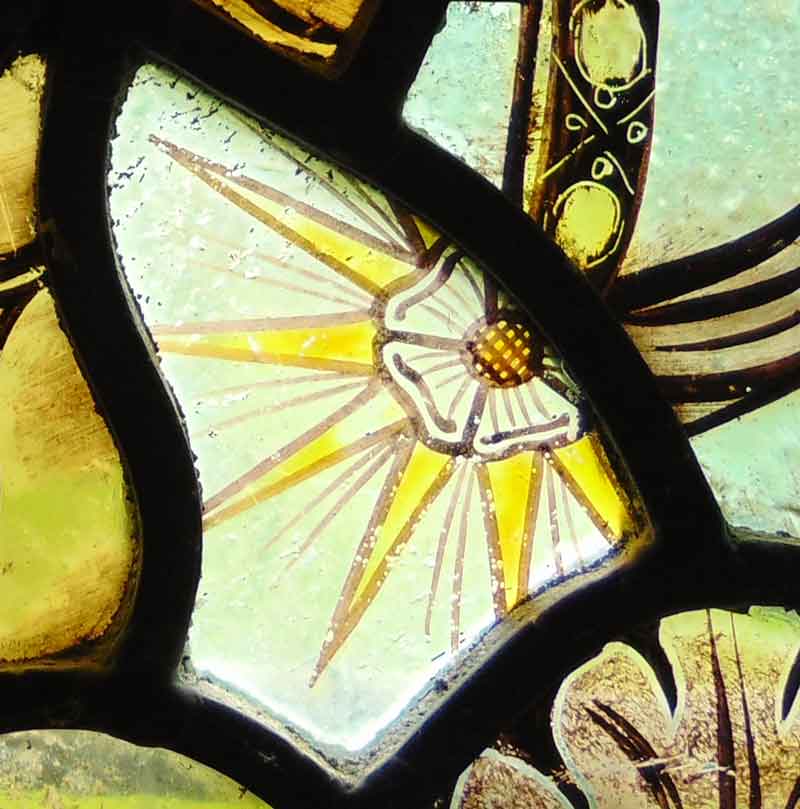
Rose and sunburst motif, Colkirk, Norfolk

The medieval glass there is most certainly of the Norwich school, and our familiar feathered angels with generic faces are evident high in the tracery. There are also fragmentary remains of the 'rose and sunburst' motif to be found amongst the glass, a symbol of the royal house of York. This suggests a likely date for the creation of the glass of between 1461 and 1483, when the Yorkists were in the ascendency, and a time when the Moundford family were at their busiest within the Wighton workshop. Glass expert David King has also studied the glass in Magdalen church, and has suggested that it is somewhat unusual in its subject matter. Although not all of the saints can be identified, those that can point to some unusual choices being made, with the inclusion of a number of only very rarely depicted additions, including St Britius, St Leger, St Callistus, and St Romanus. King believes this is due to the fact that the scheme took for its inspiration the Litanies of the Sarum Breviary, and that the glazing scheme was designed to echo the litany, and thereby act as a visual guide for the prayers of the congregation. It would most certainly make it an unusual scheme.

Where then does this leave 'our girl'? Where then does the girl in the glass fit into this cycle of litany and directed prayer? Well, the simple answer is - apparently nowhere. She doesn't fit. She is indeed entirely out of place.


This isn't the point that I launch into an extended monologue upon the litany of the Sarum breviary, you will undoubtedly be pleased to hear. Instead I simply invite you to look at the glass itself. To join me in staring at the girl in the glass, and then comparing her face, her style, her scale, with all the other saints depicted in the windows there, and it soon becomes apparent that she is indeed slightly out of place. Leaving aside the fact that her head is out of scale with the heads of the other saints painted there, the style is very different indeed. The hair and eyes are executed in a very different style, with the girl lacking the shading shown on the other heads, and she has been created with the minimal use of lines. Simplicity even. She stands out from the rest in a way that is clear to even the casual observer.

So where then does she belong? Well, we can't really say for sure. Was she even ever part of the same scheme, or even from the same church? Again we can't be sure. And the reason that we can't be sure is that the glass at Magdalen church has already seen multiple interventions, the most extensive taking place in the 1920s, when major 'restoration' was undertaken by Samuel Cladwell. Cladwell was undoubtedly talented, also working on the glass at Canterbury cathedral, but he also wasn't above moving this around a little to suit his own needs and tastes. A missing pane or panel could be replaced with another taken from elsewhere in the church, or even from somewhere else entirely. So, whilst our girl in the glass clearly doesn't quite fit in the upper reaches of the windows of the north aisle, she may always have found her home in this atmospheric church. Or not.

So I continue to stare up at her. Knowing that I will never truly know who she was, or where she was created for, or whose muse she once was. And as the light fades, and the shadows creep across the church, so too does she fade. Another day of radiant beauty passing into night, only for her to be awoken again by the first faint glimmer of the dawn. But now, in the gathering gloom, she is gone. Lost in shades of grey, as I stare up at the now opaque glass, set high in the cold stonework. I turn to go, the merest hint of an ancient soul standing beside me. A touch upon my shoulder...


Tuesday, 24 December 2019

Twas the night before Christmas - when the Devil came to visit...


Twas the night before Christmas...

The depths of Winter. A time of traditions. A time to gather together. A time to join with friends and family. A time to huddle around the flickering flames of an open fire, and tell ghost stories...


So sit back this Christmas Eve, open the Quality Street and a bottle of something, and listen to my simple tale. A story of a dark and stormy night, the curse of the Devil, and the great black demon-hound known as Black Shuck.

You should also be aware that I am trying to fit in all the major clichés before New Year - so this is only going to get worse. You've been warned. However, by now you should at least be trying to work out why there are so few of the 'purple ones' in the average tin of Quality Street, as compared to those very indistinct and tedious fudge thingies, and thanking the Lord that they usually include so few of the coconut ones, that the odd cliché should slip by fairly unnoticed. Now where was I? Ah, yes...

It was a dark and stormy night...

August 4th, 1577. It began with the wind. A Summer breeze that gradually grew in strength as the daylight began to fade. Dark clouds gathered, and the people of the little town of Bungay, nestled in the Waveney valley on the Norfolk/Suffolk border, cast anxious glances to the sky. Lammas was just past, and for many this marked the beginning of the harvest season. A time for gathering in the crops, and long days out in the fields. But now a storm was coming, driven before the wind, and the harvest would be threatened.

The first drops of rain began to fall. Heavy and large as they splattered in to the dry earth, audible as they hammered into the lead and tile of the church roof. The sky was black now, a swirling mass of cloud, bringing darkness to the land long before the late Summer evening was due. And then came the thunder. Great echoing claps of thunder that cracked across the sky, and rolled down the valley above the Summer shrunken river. A storm was coming.


But this was no ordinary storm. This was no Summer blow, over and forgotten about in a few short hours, leaving the world refreshed and bright. This was a storm being driven by the devil. The rain began to pound and pummel the earth, beating down crops, turning to red ruin the soft fruits of the cottage gardens, and shredding the leaves on the trees where they stood. The thunder cracked across the sky, and flashes of bright white only lent greater form to the dark mass of boiling cloud, driven in to crazed patterns by the coiling wind. The devil himself had come to Bungay.

In fear, and fearing for their homes, lives and livelihoods, the good people of Bungay - for there were a few good people amongst them - ran to their place of safety. Through the driving mass of rain, and with the wind now screaming the devil's wrath around them, they made for the church. The great stone-built refuge that would protect them from the weather and the evil that came at them from the sky. And there, in the semi-darkness of an unnatural night, they cowered around guttering candles as the great storm hammered down onto the land. Hammered down on to their church.

The drawn faces of the terrified townspeople raised their eyes upwards, uttering prayers to heaven, and staring hard at the church roof that the devil himself was hammering. And then it came. A great crashing blast of thunder, a blinding light, and the doors of the church burst inwards - letting loose the devil within the church. In the shape of a great black hound, the devil leapt down the nave, crashing through the terrified townspeople, and leaving death and destruction wherever his great black paws touched. With wild mad eyes, the great beast lashed out, and bodies were tossed aside. Blood flowed, and white fire flicked across the heads of the cowering congregation. The church itself shook, the stones tearing themselves apart as the devil caressed them, and the spire came crashing down. Timber splintered, glass shattered, and the people were cast aside as the devil did his work. Death came to Bungay.

"All down the church in midst of fire, the hellish monster flew, and, passing onward to the quire, he many people slew".

By the time the storm began to die away, driving onwards to cause more destruction at Blythburgh in Suffolk, the church of St Mary was a wreck. The spire had gone, driven down through the roof of the nave, and amongst the mass of injured and bewildered people lay two forms that would move no more. The devil had come, and his price had been the lives of a man and boy, both burnt and curled amongst the debris. Their bodies as broken as the church around them. But the devil had left them again, and of the great hell-hound there was no sign. The beast had vanished with the storm, leaving only great burn marks upon the church door, where his claws had bitten into the timbers. The mark of the devil.

Taper burn marks on the door of Bungay church

And there they remain to be seen to this day. The claw marks of the great beast - the devil in animal form - burnt into the timbers of the ancient church door. Great claw marks of darkness, bearing witness to those terrifying events of that tragic night. The devil has left his mark upon the church. A warning to all, and a story that they tell in Bungay to this day, as visitors come to see the devil's paw print on the door of the church.

Except that they’re not, of course. But why let facts stand in the way of a good ghost story? Far more handy to claim some kind of notoriety for your town that is most likely the only interesting thing to have happened there. The marks are, of course, what we today term 'taper burn marks'. Deliberate burns placed upon the fabric of buildings to ward off evil, to protect the building and its inhabitants from harm, created by a light designed to drive out the darkness. Although once thought to have been created accidentally, the result of the careless use of tapers and candles, today they are generally accepted as having been made deliberately - for the most part. Experimental archaeology has also shown that they are actually rather tricky little blighters to create accidentally. The candle must be held against the timber at just the right angle, for just the right length of time, before the charred timber is scraped away, and the flame reapplied. And we are coming across them all over the place, in sometimes quite astonishing numbers. Sites such as Little Morton Hall, Gainsborough Old Hall, Plas Mawr, Knole, Sissinghurst Castle - all boast many hundreds of examples. However, it is of churches and the devil that we speak...

Edingthorpe church, Norfolk.

What seems exceedingly strange to me these days is just why the taper burn marks on the church doors at Bungay and Blythburgh have received quite so much attention? Why these two sites have been singled out, and stories grown up around these particular marks? They are, after all, not really very unusual at all. Now we know what we are looking for, and actually take the time to look, we find that these taper burn marks on church doors are actually commonplace. Sorry Bungay. Sorry Blythburgh. You aren't that special. In fact, if you visit an East Anglian church, and it has any of the original doors still in situ - be it the south door, north door, or even the west doors - then there is roughly a fifty percent chance that, on the back of it you will find taper burn marks. And it isn't just East Anglia, although we may have a higher percentage of surviving medieval doors than elsewhere. The same taper burn marks are found on the back of church doors across the country. There are also very probably a lot more out there we haven't noticed as yet. When we first began recording graffiti inscriptions in English churches a decade ago taper burn marks simply weren't on our radar. We didn't really look for them, and if they were present they were most probably overlooked, so there are almost definitely others out there that we have missed. Perhaps hundreds of marks on the backs of church doors.

So there is the first thing to note. The marks are found on the back of the church door. On the inside of the church. I'm sure there are exceptions to this rule out there, but they are few and far between. Even where the outside face of the door has been protected from weathering, that might eat away at any marks there, no such marks are found. It's only the inside face of the door that has them.

St Edmund's church, Acle, Norfolk.

And then there are the marks themselves. We have now recorded so many that there are certain patterns starting to emerge. Patterns that might be missed when viewing each site in isolation. So, whilst there are sites like Blythburgh and Bungay, where you have multiple burn marks on the back of the doors, these are a little bit unusual (there you go Blythburgh and Bungay, you are still a 'tiny' bit different). The majority of sites where these marks are being recorded tend to only have a single burn mark. A single taper burn - slap bang in the middle of the doorway. Just the one. It doesn't matter whether it's the north, south or west doors, and in the case of Brent Eleigh in Suffolk all three, but it will be just a single applied burn mark in the centre of the reverse of each door. Sometimes the mark is only lightly applied, but just as often it has been burnt and re-burnt, until the distinctive teardrop shape forms a deep hollow in the surface of the wood. In eastern Suffolk Timothy Easton has also noted that the marks are to be found alongside 'peep-holes' through the door. However, these 'peepholes' don't seem particularly common across the region, so in the sixty-plus sites where I have recorded these marks none were near such holes - because there weren't any holes. They are, after all, funny buggers down there in Suffolk.

Take the church at Brent Eleigh for example. A church that's worth a visit for just so many reasons. The medieval wall paintings in the chancel are simply stunning (and covered in early graffiti), the graffiti on the tower arch is a bit special too, as is the very fine parclose screen at the end of the south aisle. The locals are friendly, and very interested in the history of their lovely church, and they are quite used to people rocking up to stare at the walls. The church also appears to have all of its pre-reformation doors still intact - south, north, and at the west end - and all display taper burn marks. They don't quite follow what I have come to think of as the 'typical' pattern, but are still noteworthy. Where the two leaves of the door join you will find deeply burnt marks, extending on to each door. Each door also has a secondary mark applied, right in the centre. The placement appears very deliberate. Very precise.
Medieval wall paintings at Brent Eleigh, Suffolk

So what the actual feck is going on? These aren't quite the same patterns we are seeing in vernacular architecture, where the marks are associated with thresholds, gaps, openings, and vulnerable points such as chimneys and fireplaces. Certainly, in cases such as Brent Eleigh, you can argue that the marks are being placed at vulnerable points - where there may be a gap between the two doors, but at most of the sites this isn't the case. Just a single taper burn mark bang in the middle of the door. Is this offering some form of protection to the door as a whole? Protecting the entrance? Tempting... but probably not.

And the reason I say probably not? Because, as usual, I'm only telling you half the story.

There is another place in churches where we have also begun to regularly come across these taper burn marks. Not just on the doorways, but also on the medieval timber screens that divide areas of the church, one from the other. The rood screens between nave and chancel, and in particular, the parclose screens that divide off areas of the aisles, most usually to create a small chapel within the wider body of the church. And these marks are not to be found on the doorways through these screens, but on the main bodies of the screens themselves. The rails and dados, the panels and mullions. The screens may mark the divisions between areas of the church, and the doors in them mark the thresholds, but the screens are by their very nature permeable. The upper sections a delicately carved lacework of tracery and geometric designs. More air than timber.

So these marks do not add protection to a vulnerable threshold, but rather mark a whole boundary. They delineate a space, and divide the one from the other. The nave from the chancel, the outside from the inside. And this is a pattern we have seen elsewhere. A pattern that has been also noted in some of our vernacular buildings, where the taper burn marks are not gathered around the doorways, but rather spread around a room or space. At Gainsborough Old Hall for example, where the steward's room has a single taper burn mark placed centrally along each section of the four walls, both delineating and protecting a space. Marking out those boundaries.

Because boundaries are dangerous, and thresholds are just one example of a boundary. All boundaries mark the change from one to the other, be it from one space to the next, from inside to outside, or from dark to light. From light to dark. So on this evening in the depths of Winter, as the world shifts across another boundary, and we celebrate both the darkness, and the promise of future light, be wary. Boundaries are dangerous places... and the devil prowls the boundaries.