It is the eyes that are hard to forget. Heavily lidded, and
almost sleepy, they stare past you at something sitting a few inches over your
shoulder. They never look at you, and if I was asked to describe their colour I
couldn't. I'd probably suggest a deep, rich brown, but with no element of
conviction in my voice. For the colour has been drawn more from my imagination
than from the reality before me. Oh, the hours I have spent staring at her
form. Slowly caressing each tiny line of her face, admiring the full lips, and
tracing the soft curve of her throat with my eyes.
And she is always there. Waiting for me, or so I like to
think. Always there, and always perfect. I have stared at this beauty as the
years have passed, in many a church. As I grow older, and fade from this world,
she remains the same. Her beauty never fading. Timeless in the light.
She is the girl in the glass.
 |
| Wiggenhall St Mary Magdalen |
I can't say exactly when I first saw her. It was many years
past, and I forget the exact moment. She sits high in the windows of the north
aisle of the church of St Mary Magdalen, Wiggenhall. A small fragment of what
was once a far larger scheme of medieval glass that would have once filled
these great spaces with coloured light. A quiet reminder that, despite the
building feeling as though its ancient stones have remain unchanging and
resolute, these old walls have seen more than their fair share of comings and
goings, of alterations and transformations. For five centuries the girl in the
glass has looked down on an ever changing, and eventually dwindling,
congregation, whose brief lives must have seemed like mayflies in her eyes.
Brief flashes of vitality across the flagstones, before they too were planted
outside amongst their ancestors. Yet there she has remained, through
reformation, civil war, famine and pestilence. A small fragment of painted
glass with a story to tell.
The glass here belongs to a stylistic group known today as
the 'Norwich school'. East Anglia is rightly famous for its medieval stained
glass, and given the zeal of the iconoclasts in the sixteenth and seventeenth
centuries, the amount of examples we have left - that have survived the stones
and hammers of those who would smash their pale faces from the walls - really
is something of a little miracle. There are several almost complete windows,
such as the magnificent Toppes window in St Peter Mancroft church in Norwich,
or the great expanse of glass in the east window at East Harling church - both
repaired - but both unquestionable masterpieces. Scattered across the region
you will also come across dozens of other churches that still proudly display
their medieval glass - Warham, St Peter Hungate, Cley, Elsing, Stratton Strawless,
Mileham, Ketteringham - to name but a handful. In some cases the medieval glass
has been re-set within more modern restoration schemes, in others, such as at
Colkirk, windows have been created from a surviving jumble of fragments,
creating a mosaic of light that hides a wealth of charming, and sometimes
disturbing, details.
 |
| Sir Robert Wingfield, East Harling church, Norfolk. |
The glass that can be attributed to the Norwich school is distinctive,
and contains a number of elements and characteristics that set it well and
truly apart from other English glass of the period. The most obvious are the angels.
Angels with curling golden hair, and suits of feathers - mimicking, some claim,
the suits worn by those taking part in mummers plays of the period. The angels
are more than distinctive, and are often shown playing a variety of medieval
instruments, and are to be found at multiple churches across the region.
Indeed, so alike are these angels that it is even possible to superimpose an
angel from one site with an angel from many miles away. Copied from the same
pattern-book, or drawn by the same hand. The faces of the angels are generic.
Pleasing most usually, but of a generic 'type'. And I'm not even going to begin
to discuss their earlobes.
 |
| Norwich school feathered angels, Hungate, Norwich. |
These are the glorious Norwich school angels. A motif and
style that appear so often that they are the generic tell-tale amidst many
fragments of reformed glass. The marker of a single school, workshop, or even
craftsperson.
 |
| Norwich school feathered angel, Bale, Norfolk |
It isn't just the feathered angels with their generic that
make the Norwich school distinctive. It is also the other faces they captured
in the glass. The faces of the saints, and of the sinners. Faces that display
the distinctions of reality upon them. Dark lines in the glass, capturing the
essence of the individuals; their orbits marked out in the finest of
brushstrokes, a loose curl of hair escaping from beneath a veil, and pale
shadows showing depressions of their chins. These are, you cannot help but
feel, images of real people. Portraits captured for centuries in the thinnest
of fragile glass. These are, perhaps, the faces that they saw around them every
day. The population of late medieval Norwich, fossilised in the glass of the
furnace. Are these in fact the very crafts men and women of the Norwich school
itself, or perhaps their friends and family, or the face of the girl they
passed each day in the street?
In the most general of terms we really know very little
about individual medieval artists and craftsmen. Unless they worked for the
very elite echelons of society, including the major aristocracy or royal
household, their names are generally lost to us. They only rarely signed their
work, and it is unusual to be able to link and individual craftsperson to an
individual piece of work. Their testaments are the works of sublime art that
they left behind them, and their fame is often limited to being described, not
by their own name, but as the 'Master of...'.
 |
| Warham St Mary, Norfolk. |
However, this isn't quite the case when it comes to the late
medieval stained and painted glass associated with the 'Norwich school'. Thanks
to the work of scholars such as David King, and the Rev. Charles Woodforde, we
actually know far more about the artists and craftsmen of the Norwich school
than about almost any other group of craftsmen operating in late medieval
England. We know, to a certain extent, how they operated from day to day, where
some of their physical workshops were located, and even about the family
relations involved within certain groups. We know some of the sites they were
specifically commissioned to work on, and can link the names of individual
craftspeople to actual surviving works of art.
For example, we know of the glazier William Moundford, a
Dutchman who came to Norwich in the middle decades of the fifteenth century,
where he was a glazier in the workshop of John Wighton. Moundford married a
local woman called Helen, who is one of the few female glaziers of whom there
is a record, and together they had a son called John - perhaps named for his
Godfather and father's employer? When John Wighton eventually passed away, his
own son Thomas took over the workshop, eventually reaching the esteemed height
of Alderman within the city corporation. When Alderman Thomas too passed on, it
was the young John Moundford who appears to have continued the work of them all,
as is most probably the individual responsible for the stunning east window at
East Harling. We know too of William Heyward, a glazier who is also known to
have created monumental brasses, and that he became a freeman of the city in
1481. We know of his extensive property dealings, the fact that he had both
Robert Balys and John Trenche as his apprentices, and that he too rose through
the ranks to become a city councillor, constable, and eventually chamberlain
and alderman.
 |
| Warham St Mary, Norfolk. |
However, despite all we do know about these individuals and
their work, there is still a far greater number of things that we do not - and
probably never will. Like the re-set glass in the windows of many East Anglian
churches, we are merely piecing together broken fragments to try and make sense
of what was once a glorious whole.
So how does all this tie in with the glass in Magdalen
church, and the enigmatic girl portrayed in the glass? Can it indeed shed some
light on, if not who she might have been, but upon the individuals who created
her? Whose muse may she have once been?
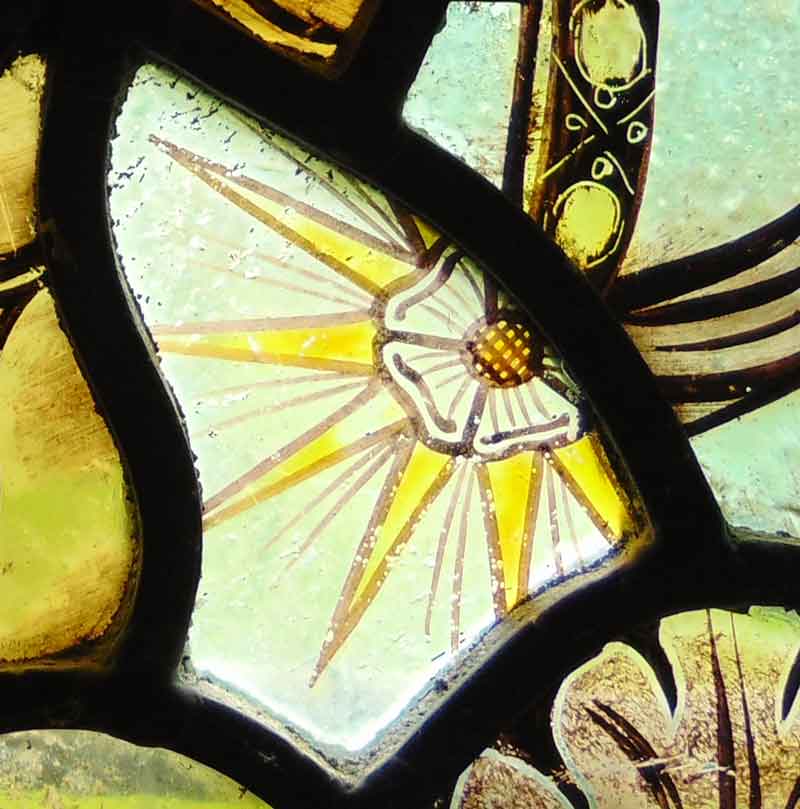 |
| Rose and sunburst motif, Colkirk, Norfolk |
The medieval glass there is most certainly of the Norwich school, and our familiar feathered angels with generic faces are evident high
in the tracery. There are also fragmentary remains of the 'rose and sunburst'
motif to be found amongst the glass, a symbol of the royal house of York. This
suggests a likely date for the creation of the glass of between 1461 and 1483,
when the Yorkists were in the ascendency, and a time when the Moundford family
were at their busiest within the Wighton workshop. Glass expert David King has also
studied the glass in Magdalen church, and has suggested that it is somewhat unusual
in its subject matter. Although not all of the saints can be identified, those
that can point to some unusual choices being made, with the inclusion of a
number of only very rarely depicted additions, including St Britius, St Leger,
St Callistus, and St Romanus. King believes this is due to the fact that the
scheme took for its inspiration the Litanies of the Sarum Breviary, and that
the glazing scheme was designed to echo the litany, and thereby act as a visual
guide for the prayers of the congregation. It would most certainly make it an
unusual scheme.
Where then does this leave 'our girl'? Where then does the
girl in the glass fit into this cycle of litany and directed prayer? Well, the
simple answer is - apparently nowhere. She doesn't fit. She is indeed entirely
out of place.

This isn't the point that I launch into an extended monologue
upon the litany of the Sarum breviary, you will undoubtedly be pleased to hear.
Instead I simply invite you to look at the glass itself. To join me in staring
at the girl in the glass, and then comparing her face, her style, her scale,
with all the other saints depicted in the windows there, and it soon becomes
apparent that she is indeed slightly out of place. Leaving aside the fact that
her head is out of scale with the heads of the other saints painted there, the
style is very different indeed. The hair and eyes are executed in a very
different style, with the girl lacking the shading shown on the other heads,
and she has been created with the minimal use of lines. Simplicity even. She
stands out from the rest in a way that is clear to even the casual observer.
So where then does she belong? Well, we can't really say for
sure. Was she even ever part of the same scheme, or even from the same church?
Again we can't be sure. And the reason that we can't be sure is that the glass
at Magdalen church has already seen multiple interventions, the most extensive
taking place in the 1920s, when major 'restoration' was undertaken by Samuel
Cladwell. Cladwell was undoubtedly talented, also working on the glass at
Canterbury cathedral, but he also wasn't above moving this around a little to
suit his own needs and tastes. A missing pane or panel could be replaced with
another taken from elsewhere in the church, or even from somewhere else
entirely. So, whilst our girl in the glass clearly doesn't quite fit in the
upper reaches of the windows of the north aisle, she may always have found her
home in this atmospheric church. Or not.
So I continue to stare up at her. Knowing that I will never
truly know who she was, or where she was created for, or whose muse she once
was. And as the light fades, and the shadows creep across the church, so too
does she fade. Another day of radiant beauty passing into night, only for her
to be awoken again by the first faint glimmer of the dawn. But now, in the
gathering gloom, she is gone. Lost in shades of grey, as I stare up at the now
opaque glass, set high in the cold stonework. I turn to go, the merest hint of
an ancient soul standing beside me. A touch upon my shoulder...


