Showing posts with label stained glass. Show all posts

Friday, 27 December 2019

The girl in the glass...


It is the eyes that are hard to forget. Heavily lidded, and almost sleepy, they stare past you at something sitting a few inches over your shoulder. They never look at you, and if I was asked to describe their colour I couldn't. I'd probably suggest a deep, rich brown, but with no element of conviction in my voice. For the colour has been drawn more from my imagination than from the reality before me. Oh, the hours I have spent staring at her form. Slowly caressing each tiny line of her face, admiring the full lips, and tracing the soft curve of her throat with my eyes.

And she is always there. Waiting for me, or so I like to think. Always there, and always perfect. I have stared at this beauty as the years have passed, in many a church. As I grow older, and fade from this world, she remains the same. Her beauty never fading. Timeless in the light.

She is the girl in the glass.
Wiggenhall St Mary Magdalen

I can't say exactly when I first saw her. It was many years past, and I forget the exact moment. She sits high in the windows of the north aisle of the church of St Mary Magdalen, Wiggenhall. A small fragment of what was once a far larger scheme of medieval glass that would have once filled these great spaces with coloured light. A quiet reminder that, despite the building feeling as though its ancient stones have remain unchanging and resolute, these old walls have seen more than their fair share of comings and goings, of alterations and transformations. For five centuries the girl in the glass has looked down on an ever changing, and eventually dwindling, congregation, whose brief lives must have seemed like mayflies in her eyes. Brief flashes of vitality across the flagstones, before they too were planted outside amongst their ancestors. Yet there she has remained, through reformation, civil war, famine and pestilence. A small fragment of painted glass with a story to tell.

The glass here belongs to a stylistic group known today as the 'Norwich school'. East Anglia is rightly famous for its medieval stained glass, and given the zeal of the iconoclasts in the sixteenth and seventeenth centuries, the amount of examples we have left - that have survived the stones and hammers of those who would smash their pale faces from the walls - really is something of a little miracle. There are several almost complete windows, such as the magnificent Toppes window in St Peter Mancroft church in Norwich, or the great expanse of glass in the east window at East Harling church - both repaired - but both unquestionable masterpieces. Scattered across the region you will also come across dozens of other churches that still proudly display their medieval glass - Warham, St Peter Hungate, Cley, Elsing, Stratton Strawless, Mileham, Ketteringham - to name but a handful. In some cases the medieval glass has been re-set within more modern restoration schemes, in others, such as at Colkirk, windows have been created from a surviving jumble of fragments, creating a mosaic of light that hides a wealth of charming, and sometimes disturbing, details.

Sir Robert Wingfield, East Harling church, Norfolk.

The glass that can be attributed to the Norwich school is distinctive, and contains a number of elements and characteristics that set it well and truly apart from other English glass of the period. The most obvious are the angels. Angels with curling golden hair, and suits of feathers - mimicking, some claim, the suits worn by those taking part in mummers plays of the period. The angels are more than distinctive, and are often shown playing a variety of medieval instruments, and are to be found at multiple churches across the region. Indeed, so alike are these angels that it is even possible to superimpose an angel from one site with an angel from many miles away. Copied from the same pattern-book, or drawn by the same hand. The faces of the angels are generic. Pleasing most usually, but of a generic 'type'. And I'm not even going to begin to discuss their earlobes.

Norwich school feathered angels, Hungate, Norwich.


These are the glorious Norwich school angels. A motif and style that appear so often that they are the generic tell-tale amidst many fragments of reformed glass. The marker of a single school, workshop, or even craftsperson.

Norwich school feathered angel, Bale, Norfolk

It isn't just the feathered angels with their generic that make the Norwich school distinctive. It is also the other faces they captured in the glass. The faces of the saints, and of the sinners. Faces that display the distinctions of reality upon them. Dark lines in the glass, capturing the essence of the individuals; their orbits marked out in the finest of brushstrokes, a loose curl of hair escaping from beneath a veil, and pale shadows showing depressions of their chins. These are, you cannot help but feel, images of real people. Portraits captured for centuries in the thinnest of fragile glass. These are, perhaps, the faces that they saw around them every day. The population of late medieval Norwich, fossilised in the glass of the furnace. Are these in fact the very crafts men and women of the Norwich school itself, or perhaps their friends and family, or the face of the girl they passed each day in the street?

In the most general of terms we really know very little about individual medieval artists and craftsmen. Unless they worked for the very elite echelons of society, including the major aristocracy or royal household, their names are generally lost to us. They only rarely signed their work, and it is unusual to be able to link and individual craftsperson to an individual piece of work. Their testaments are the works of sublime art that they left behind them, and their fame is often limited to being described, not by their own name, but as the 'Master of...'.

Warham St Mary, Norfolk.

However, this isn't quite the case when it comes to the late medieval stained and painted glass associated with the 'Norwich school'. Thanks to the work of scholars such as David King, and the Rev. Charles Woodforde, we actually know far more about the artists and craftsmen of the Norwich school than about almost any other group of craftsmen operating in late medieval England. We know, to a certain extent, how they operated from day to day, where some of their physical workshops were located, and even about the family relations involved within certain groups. We know some of the sites they were specifically commissioned to work on, and can link the names of individual craftspeople to actual surviving works of art.

For example, we know of the glazier William Moundford, a Dutchman who came to Norwich in the middle decades of the fifteenth century, where he was a glazier in the workshop of John Wighton. Moundford married a local woman called Helen, who is one of the few female glaziers of whom there is a record, and together they had a son called John - perhaps named for his Godfather and father's employer? When John Wighton eventually passed away, his own son Thomas took over the workshop, eventually reaching the esteemed height of Alderman within the city corporation. When Alderman Thomas too passed on, it was the young John Moundford who appears to have continued the work of them all, as is most probably the individual responsible for the stunning east window at East Harling. We know too of William Heyward, a glazier who is also known to have created monumental brasses, and that he became a freeman of the city in 1481. We know of his extensive property dealings, the fact that he had both Robert Balys and John Trenche as his apprentices, and that he too rose through the ranks to become a city councillor, constable, and eventually chamberlain and alderman.

Warham St Mary, Norfolk.

However, despite all we do know about these individuals and their work, there is still a far greater number of things that we do not - and probably never will. Like the re-set glass in the windows of many East Anglian churches, we are merely piecing together broken fragments to try and make sense of what was once a glorious whole.

So how does all this tie in with the glass in Magdalen church, and the enigmatic girl portrayed in the glass? Can it indeed shed some light on, if not who she might have been, but upon the individuals who created her? Whose muse may she have once been?
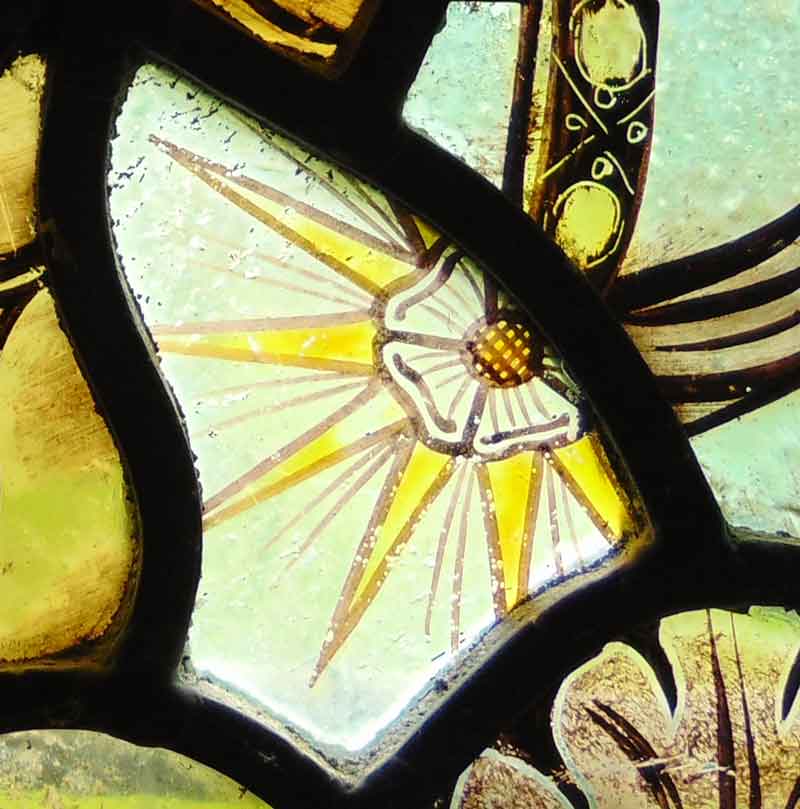
Rose and sunburst motif, Colkirk, Norfolk

The medieval glass there is most certainly of the Norwich school, and our familiar feathered angels with generic faces are evident high in the tracery. There are also fragmentary remains of the 'rose and sunburst' motif to be found amongst the glass, a symbol of the royal house of York. This suggests a likely date for the creation of the glass of between 1461 and 1483, when the Yorkists were in the ascendency, and a time when the Moundford family were at their busiest within the Wighton workshop. Glass expert David King has also studied the glass in Magdalen church, and has suggested that it is somewhat unusual in its subject matter. Although not all of the saints can be identified, those that can point to some unusual choices being made, with the inclusion of a number of only very rarely depicted additions, including St Britius, St Leger, St Callistus, and St Romanus. King believes this is due to the fact that the scheme took for its inspiration the Litanies of the Sarum Breviary, and that the glazing scheme was designed to echo the litany, and thereby act as a visual guide for the prayers of the congregation. It would most certainly make it an unusual scheme.

Where then does this leave 'our girl'? Where then does the girl in the glass fit into this cycle of litany and directed prayer? Well, the simple answer is - apparently nowhere. She doesn't fit. She is indeed entirely out of place.


This isn't the point that I launch into an extended monologue upon the litany of the Sarum breviary, you will undoubtedly be pleased to hear. Instead I simply invite you to look at the glass itself. To join me in staring at the girl in the glass, and then comparing her face, her style, her scale, with all the other saints depicted in the windows there, and it soon becomes apparent that she is indeed slightly out of place. Leaving aside the fact that her head is out of scale with the heads of the other saints painted there, the style is very different indeed. The hair and eyes are executed in a very different style, with the girl lacking the shading shown on the other heads, and she has been created with the minimal use of lines. Simplicity even. She stands out from the rest in a way that is clear to even the casual observer.

So where then does she belong? Well, we can't really say for sure. Was she even ever part of the same scheme, or even from the same church? Again we can't be sure. And the reason that we can't be sure is that the glass at Magdalen church has already seen multiple interventions, the most extensive taking place in the 1920s, when major 'restoration' was undertaken by Samuel Cladwell. Cladwell was undoubtedly talented, also working on the glass at Canterbury cathedral, but he also wasn't above moving this around a little to suit his own needs and tastes. A missing pane or panel could be replaced with another taken from elsewhere in the church, or even from somewhere else entirely. So, whilst our girl in the glass clearly doesn't quite fit in the upper reaches of the windows of the north aisle, she may always have found her home in this atmospheric church. Or not.

So I continue to stare up at her. Knowing that I will never truly know who she was, or where she was created for, or whose muse she once was. And as the light fades, and the shadows creep across the church, so too does she fade. Another day of radiant beauty passing into night, only for her to be awoken again by the first faint glimmer of the dawn. But now, in the gathering gloom, she is gone. Lost in shades of grey, as I stare up at the now opaque glass, set high in the cold stonework. I turn to go, the merest hint of an ancient soul standing beside me. A touch upon my shoulder...


Wednesday, 27 July 2016

Shattered and broken: the ungodly in the house of God...

The news these days seems just so full of horror. So full of terror, death and destruction. The temptation is to simply give up reading it at all. To close your eyes and your mind to the deliberate acts of wilful hatred, in the hope that they will simply go away. It is tempting too for us to look upon these acts from afar, condemn them amongst our friends and upon social media, and to simply refer to them as though they are the acts of the uncivilised, of the unenlightened. To take nothing away from the immense individual suffering and human tragedy of it all, for those of us who care about history and cultural heritage the news is bleak indeed. Historic sites are now, well and truly, in the front line. Sacred objects are smashed, museums looted, and entire historic cultures are being wiped from the archaeological map. A modern horror inflicted upon the ancient world. As ancient temples to long forgotten gods feel the bite of sledge hammers and cheaply bought western explosives, as four thousand year old statues are smashed and scattered, it is all too easy for the good people of Budleigh Salterton or Saffron Walden to pause over their second latte, and condemn these acts as the work of bigots, zealots and the uneducated. However, it is worth remembering that it was, in historical terms, only a very short time ago that the good burghers of Melton Constable and Bishop's Stortford were carrying out just such iconoclasm in their own local parish churches.

Most people who know anything of English history understand that there was a time when we attacked our own places of worship, stripped the images from the walls and woodwork, and smashed the splendours of the medieval church. However, when confronted with such destruction the most common reaction is to place the blame fairly and squarely upon the cropped heads of Oliver Cromwell's puritan soldiery. The parliamentary stronghold of East Anglia, swarming in our imaginations with bible-bashing puritans and roundhead ironclads, most certainly suffered such attacks during the period of the English Civil Wars of the mid-seventeenth century. However, in terms of the destruction of the artworks and glories of the medieval church the real damage had been done over half a century before Oliver and his shock troops had even been born. Whilst there are cases of such seventeenth century destruction, with the notebooks of the notorious iconoclast William Dowsing still surviving in witness to these acts, the churches that they entered had already been largely stripped of their medieval beauty. To place the blame upon the roundheads is, in some respects, to follow the easy route. It is simple to look at the itinerant puritan fanatics and the visiting rough soldiery and conclude that it was violence born of indoctrination and ignorance. It is far harder to accept that such wanton destruction, such an attack on beauty and devotion, was actually carried out by the parishioners themselves. That such iconoclasm was undertaken by, in some cases, the children and grandchildren of the people who made bequests and offerings to create such objects of beauty in the first place.


In 1530 the parish church was essentially medieval in character. A place of vibrant wall paintings, bright stained glass, luminous alabasters and gaudily painted statues. A place of imagery, angels and the saints. By 1550, only two decades later, almost all of this was gone. The statues had been taken down, much of the glass was gone, the rich embroidered vestments had been sold off, and the wall paintings lay hidden beneath coat upon coat of fresh lime-wash. Whilst the changes were monumental they were also incremental. While it may be true to say that the process was begun, as many people will undoubtedly assume, in the closing years of the reign of Henry VIII, the process was a relatively slow one. Many of the major changes, changes that we still see around us today, actually took place long after Henry's death, in the short but turbulent reign of his son Edward VI.

Under the influence of 'reforming' advisors, and brought up to be a devout protestant, Edward oversaw the deliberate and piecemeal destruction of the medieval catholic church. It was a targeted and sustained attack on the fabric, furnishings and social structure of the medieval parish. Whilst some have argued that these were changes welcomed by many at a parish level, as evidenced by the lack of resistance to the changes themselves, it must be noted that the reformation was a gradual process. It was a gradual chipping away at the foundations of medieval faith and belief, until the whole structure had been built anew. It was a series of small acts, each in itself largely innocuous, that taken together resulted in fundamental change.

Bressingham, Norfolk

It was the statute against the veneration of images that left such a trail of obvious destruction that can still be traced through almost every East Anglian church. The act was uncompromising, with orders being given to ‘utterly extinct and destroy’ images ‘so that there remain no memory of the same’. It was this act that led to the covering over of wall paintings, the dismantling or defacement of rood screens, angel roofs and stained glass windows. At Bressingham in south Norfolk the masterpieces of carving that decorated every bench end were attacked with chisels, with each human face hacked from the timber. At North Elmham the world class painted panels that formed the rood screen were removed from their frames, turned upside down and used as floor boards. At Colkirk the beautiful late medieval glass panels were smashed from the tracery, only for fragments to be recovered from the churchyard centuries later. At Houghton St Giles the parish chose to leave the magnificent rood screen in place, but instead roughly gouged out the complete faces of every individual saint, whilst at mighty Attleborough church the multi-tiered doom painting above the chancel arch disappeared for centuries beneath layers of whitewash. It was, quite simply, an attack on medieval art of a scale never seen before or since; destruction on a truly horrific scale.
North Elmham, Norfolk

What is perhaps the most surprising thing is just how much beauty has survived in East Anglia's churches. Given the periods of destruction and unrestrained iconoclasm, the fact that almost every church, almost without exception, contains at least one noteworthy survival is something of a puzzle - but something also to be endlessly thankful for. It is clear that in some cases, as at North Elmham, the survival of such rare beauty was simply a matter of chance. In other cases though it must have been a matter of deliberate choice. A parish that saw those objects of, now unorthodox, beauty and chose to defy or ignore directions for their destruction. A congregation for whom the links created by such objects to their own parish past, and their own ancestors, was far too strong to simply be put aside on the orders of a distant authority.

It would, however, be wrong to assume that such objects were destroyed without thought and without care. At the tiny parish church of Wellingham in central Norfolk can still be seen one of the very last medieval rood screens made in East Anglia prior to the reformation. The upper section has been long gone for centuries, but the lower section still survives - and it is a rare survival indeed. Images of St George and the dragon, St Sebastian, and Christ accompanied by the instruments of the Passion, are almost as fresh today as on the day they were first painted. The screen was a gift to the church in memory of Robert Dorant and his wives, with the dedicatory inscription dated 1532 - a bare few years before the first stirrings of the reformation that would lay waste hundreds of screens just such as this one. However, in Wellingham, the parish appears to have taken a different approach. The parishioners chose to follow the injunction against imagery, but in the most half hearted way possible. Many of them would have undoubtedly still remembered Robert Dorant and his wives, and so the action they took was barely action at all. Although some of the faces are gone from the screen, St George's horse being one puzzling example, many of the other bear only the very lightest of scratches. A few neatly incised crosshatched lines made with the very sharpest of knives. The screen had been defaced - but you would have had to get pretty close to it, as you do today, to even notice the markings. They had done their duty by the law, the church, and the king - but more importantly done their duty to the memory of old Robert.
Wellingham, Norfolk


Such restraint wasn't just to be found at Wellingham. The stunning screen at Thornham on the Norfolk coast, donated to the church in the late fifteenth century by the wealthy local merchant William Millar, suffered similarly half-hearted scratchings - leaving us, thankfully, with another medieval jewel in the crown of East Anglian churches. Such restraint, particularly under pressure from both church and state, must have been by parish-wide agreement. A tacit understanding to do only the very minimum that was required. Whilst the fundamentalists may have held sway within the administration what occurred at a parish level was, quite frankly, the business of the parish. Sadly such cases were not the norm.

Thornham, Norfolk


At Binham priory, a few miles south of the north Norfolk coast, is perhaps one of the most poignant reminders of the destruction caused by the fundamentalism of the English reformation. Encased now behind perspex is the forlorn remains of what must have once been one of the most beautiful rood screens in the region. The upper section, undoubtedly once filled with delicately carved timbers and fine tracery, has long since gone; recycled, destroyed, or simply crumbled to dust by centuries of woodworm and rot. However, part of the lower section, the dado, survives. During the reformation, as most of the priory was dismantled around it, leaving only the nave to act as the parish church, this section was redecorated. In line with the official policy of the day, the images of the saints were lime-washed over. With a new emphasis being placed upon the word of God, rather than elaborate imagery, the screen was covered instead the excerpts of religious text. This seemingly wanton destruction was also one of the most beneficial acts of the whole reformation, for instead of being defaced and destroyed, the images of bright faced saints were preserved fully intact beneath the later paintwork. Now, nearly five centuries later, the lime-wash of the reformation has begun to peel from the surface of the screen. The panels of text are literally falling away from the woodwork, and the faces of the golden robed saints, are once more being revealed in all their original glory and splendour. So here, at least at this one special site, the effects of a small part of the English reformation were only temporary, and the saints are once more returning the Binham...

Binham Priory, Norfolk


Monday, 24 August 2015

No Angels - just Demons...

If you wander into just about any medieval church in England, or at least one that hasn't been too heavily messed around with by the Victorians and their brutal concepts of restoration, then they are all around you. The angels and demons. You may not see them immediately, they may not leap out at you, but they are there. Quietly watching, as they have been down the long centuries, through the brightest of Summers - and the bleakest, darkest of midwinters. They will be there, as they were through the tumult of the reformation, the dark days of that most uncivil of civil wars, and the long, long years of the nineteenth century. They have survived wars, plague, famine and fire - and will still be there long after you and I have become nothing more than faded memory to a jaded world. Still there, still watching - the angels and demons of the medieval church.
The angels and demons are sometimes easy to see. The carved angels that support the timbers of the most complex and inspiring of roof trusses. Wings outstretched and, despite the impact of many a sour hearted puritan musket ball, still glowing with their original colour. Angels carved in attitudes of prayer on dark oak bench-ends; details worn smooth and pale by the passage of a thousand caressing hands and the passing of the years. And then there are the angels of light. Those ethereal creatures that survive in stained and painted glass, that radiate sunlight in a dozen different colours, and who watched on in mute horror at the destruction wrought upon many thousands of their fellows. Who watched as painted majesty became mere fragments of shattered glass, and windows fell from golden glory to become mere holes to let in the light. And the others. The ones that still adorn the walls in a bare handful of churches. Those that sit upon the right hand of God in the Doom paintings that once shouted out their message of salvation and damnation from above the chancel arch, giving a helping hand to those souls that were destined for the eternal joys of heaven. And, in a few remote and blessed churches such as Barton Turf in Norfolk, the massed choirs of angels that march in triumph along the painted panels of the rood screen, missing only the faces that once so offended the iconoclast reformers.
And then there are the demons. The grinning, contorted faces that balance their angelic counterparts above the chancel arches, casting the souls of the damned down into the pit; an open mouthed devil that spews forth flames and the stink of sulphurous burnt flesh. The carved wooden demons that decorate the misericords in dozens of church choirs, grinning lewdly up at the fat clerical arse above them. The demonic gargoyles and grotesques that roost and colonise the corners and buttresses of a hundred church towers; leering, jeering and fondling themselves in an attempt to drive off the evil eye and outrage the rector and timid goodwife. You are never far from the demons of the medieval church. Peeking from behind stiff-leaved stone foliage, peering down from the rafters, or scuttling beneath the choir stalls. They are there. Their millennia long battles with the angelic host put aside at the creaking of a church door, a glimpse of sunlight, and your arrival...
Our churches are full of angels and demons. The product of a medieval theology that, in essence, boiled down to 'no Devil = no God'. The church NEEDED devils and demons to exist, to balance each other out and show that salvation wasn't a given; that the fate of your soul was in your own hands, and that a single act on your own behalf would determine which side of the chancel arch you would eventually find yourself on. The battle between the light and the dark wasn't won, but was an ongoing struggle that, despite God's reassurance of eventual victory over Satan, would have many casualties along the way. A battle that, you would expect, would be echoed in the graffiti on the walls of our churches. It isn't.
There are certainly echoes of the great medieval battle for the souls of the congregation amongst the thousands of graffiti inscriptions that we have recorded. The multitude of apotropaic marks that adorn almost every surface you can think of, designed to ward off evil and the unkindly, death bringing, gaze of the ever watchful evil-eye. There are the prayers too. The names of God etched into the stones, the Latin invocations and the images of hands raised, and forever frozen, in the act of blessing and benediction. And there are the demons there too. Etched deep into the surface, like the wide-mouthed, sharp toothed demon of Troston, or the devil of Beachamwell; armed with a metal meat-hook, to strip the eternal souls of the damned from their earthly and stinkingly corrupt flesh. The demons are to be found everywhere. Staring right back at you from the walls.  But where then are the angels on the walls? Where are the agents of eternal balance, that celestial militia whose vigilance keeps the evil at bay? They are simply not there. They have not been obliterated with the passage of time. No Victorian restoration has wiped them from the walls. The massed ranks of Demons did not drive them upwards to the rafters in one last great battle across the stonework. They are simply not there, and never have been.
This is something that has only really occurred to me in the last few months. After many years of hunting down and recording medieval graffiti inscriptions. As the numbers of recorded inscriptions grew into the thousands, and then the tens of thousands, so too did the number of demons that we recorded. Demons from all over the country, from all manner of churches, hidden in all manner of places. But no angels. One 'possible' angel that came to light only very recently; the statistical anomaly that we can never apparently do without, but no serried ranks of the angelic host. They aren't were you might expect them to be, and the question has to be why?
There is, I believe, a really quite simple answer. An answer that the graffiti itself points us towards. Whilst the walls of our churches may be reflections of medieval beliefs, they are reflecting only certain aspects of that belief. They do not show us everything, but only those things that, to the members of the medieval congregation, were real and to be feared. The walls of our churches are a testament to the fears and horror of the medieval mind. The angels were not in that class. Angels are part of the orthodox church; the ethereal long-hoped-for salvation of the soul - but they had no part in this world. In this reality. People were not visited by angels on a regular basis, with a few notable and usually frowned upon enthusiastic exceptions, and the angels were largely reserved for the divine. Their images may adorn the windows of the church, and be carved into the ornate woodwork of the pews, but that was the only hold they had in this world. Demons on the other hand were all too real. All too much a part of the everyday reality of the medieval parish. It was the demons that brought the life threatening illness of a much loved child. It was the demons that caused the unexplained death of a much needed sow. It was the demons that brought the harvest wrecking storms, the lightning bolts from a dark sky, and the fires that could lay waste a settlement in a matter of hours. The demons were to be feared, for on earth there were no angels to stand between a naked soul and the evil that floated through the miasma that surrounded them. The dread demons could bring forth a plague that would sweep an army from the face of the battlefield, and there were no ranks of celestial militia to take their place. The demons were to be feared because they were real, they were tangible and they were there - walking amongst them. And so it is the demons who find themselves scratched into the walls of our churches alongside the prayers and blessings, alongside the apotropaic marks and the symbols of hoped-for protection.

The walls are the haunt of only the demons, not angels...

Saturday, 26 April 2014

Alway walk towards the light: the evolution of a cathedral

We were back at Norwich cathedral today to continue our survey work after a break of some months. A windy cold day, with the rain showers driving mist and spray across the cloister garth to splatter messily against the weathered stones. Not a great beginning. However, in the months we’ve been away a transformation has taken place at the cathedral. On the north side of the building three very new, and very modern, stained glass windows have been installed. They are not quite what you would expect in a medieval cathedral I suppose. All bright oranges, blues, purples and geometric shapes. They flood the north side with colour, spreading strange glowing hues across the stonework, changing as the light changes throughout the day. They add a level of mystery and wonder to an area of the cathedral which was largely a featureless thoroughfare. They bring out the warmth of the stone and highlight details and features that, in the past, I and millions of others would have just walked past without a second glance. They bring the dead stones to life.
As you can probably tell, I rather like the new windows. Didn’t really expect to that much, spending most of my time staring at the wonders of the medieval church, but I do. I like them a very great deal indeed (those who know me will tell you that, for me, such praise is gushing! I haven’t been this enthusiastic since they announced the return of Dr Who – and I was prepared to hate that too). During the day I made a point of returning to walk past the area of the new windows on several occasions. Watching how the light subtly changed as the sun moved around and how it, in turn, changed how I viewed the stonework. It was like watching a small miraculous evolution move across the cathedral walls.


However, I soon came to realise that my love for the new windows wasn’t shared by all the visitors to the cathedral, and that my passionate liking for the way the light changed was just as passionately disliked by some. Overheard comments, snatches of conversation, disparaging remarks all made it clear that to certain visitors the new glass was as welcome as an unemployed Romanian migrant at a UKIP conference.
It was the change that seemed to cause most problems. One older male visitor was explaining to his companions (a couple of very long suffering women of a certain age and a very bored looking teen girl who was continually glancing down at the mobile in her hand – willing the signal to return) that it was almost criminal to have placed such modern designs into the medieval cathedral. It was making a mockery of the original building. He finished by asking his companions what the original builders of the Norman cathedral would have thought of the new glass?  Another visitor, a woman I recognised as a reasonably well known local ‘personality’, was overheard telling her female companion that the windows were lovely – but should be in an art gallery, or the forum, rather than in the cathedral. They were, in her words, “a bit much”. If there is a more a damning judgement to be handed out by the middle classes I’ve yet to hear it.
It was rather an odd experience really. A few years ago I’m pretty sure I would have been one of the ‘bit much’ brigade. Seeing the installation of the new glass within the medieval setting of Norwich cathedral as a ‘desecration’. The work of those who care little for our medieval past and wish only to memorialise themselves and their works in the present. But I don’t – and I began to wonder why?
I came to the conclusion that it was probably because I have come to know Norwich cathedral so very well over the last few years. In the last two years, whilst we have been surveying the walls for early graffiti inscriptions, I have come to know a very great deal about that particular ‘medieval’ pile of rocks – as have all the volunteers. We have peered, pried and poked around in areas that most people walk past without a second glance. We have followed fabric changes along lines of 500 year old mortar, compared masons finishing techniques from centuries past and numbered the very stones themselves. We have unravelled the story of Norwich cathedral wall by wall and stone by stone. And we have all come to realise that the story of Norwich cathedral is not the story I once believed it to be.


The problem I suppose is one of attitude and perception. To the average visitor, and even the regular churchgoer, the cathedral is seen as a vast and unchanging monument to the medieval religious world. Shades of Ken Follet’s grubby masons still haunt the darker corners, and each carved corbel and decorated niche reflect a medieval thought, idea and ambition. It is a grade 1 museum piece that is as it was – and as it ever should be. An aspic preserved, deep pickled, gherkin of the medieval mindset. The problem is that this perception, this idea, simply isn’t true. It isn’t true at Norwich cathedral - and it isn’t true of any other cathedral anywhere either.
What my close involvement with the fabric of the cathedral has taught me is that the building is a constantly evolving vessel of worship, practical needs and ambition. Whilst we talk of it as being one of the greatest surviving Norman cathedrals in England there are actually whole sections that you are rather challenged to identify even a single original Norman stone. It has been burnt down, struck by lightning, remodelled, rebuilt and re-shaped in just about every century since it was first built. Each new generation of custodians oversees an evolutionary process to match the building to the needs of their own times. The whole of the east end has been remodelled, the façade has been replaced, the aisles altered and in the cloister it is actually quite difficult to even find areas of complete medieval stonework.
In the 15th century the spire collapsed, starting fires and bringing down the whole timber roof crashing into the nave and crossing beneath. The result was the new stone vaulted roof of Bishop Lyhart, with its world renowned roof bosses. Over 250 medieval roof bosses depicting scenes from the old and new testament that are unequalled anywhere in England. They are now one of the unique treasures of the cathedral, with visitors travelling from all over the world to crane their necks upwards and admire their painted beauty. Which is rather my point I suppose. Were there people in the 15th century who looked upwards at the new pale stonework in dismay? Where there those who felt that the warmth of the timber roof had been lost beneath the cold hard stone of the ambitious Bishop? Probably. There always are. But that new roof was simply one of many, many changes the cathedral has seen as it has evolved down the centuries. It is not, and never has been, a static building. It has never been finished and will never be complete. It will continue to evolve long after the teen girl gazing at her mobile has become a grandmother – and watched her own grandchildren wander through the soaring stonework of the cathedral.
And that is rather the point to remember here. The process is one of evolution – not revolution. The cathedral has changed once again. It will change again in the future. Long years after my dust has blown across the stones of a church somewhere in East Anglia, a new generation will be making changes to Norwich cathedral. Some people will love those changes; others will hate them. They’ll happen nonetheless and add a new chapter to the history of one of England’s finest buildings.