Tuesday, 28 June 2016

The death of heritage (part 2): playing in the ashes of the past...

It is a recognised historical fact that there are times when people are more likely to create graffiti than others. Times when society is under stress, when things are going wrong, and the people feel helpless to do anything about it. They are invariably times of conflict, either physical or social, which we term 'chronological hotspots'. Just as there are places and locations that are more likely to attract graffiti than others, there are also period of history too. You'll recognise the dates in many cases. 1939-45, 1914-18, the middle of the seventeenth century, the middle of the sixteenth century - and of course 1349. Put simply, when things go bad, when chaos comes knocking, people start writing on the walls.

I'm expecting a really good crop of graffiti from the last week. A large and REALLY good collection.

The last week has been... interesting. Interesting from many perspectives. From an outside historical perspective it has been totally fascinating. Watching a society once known for its tolerance and pragmatism collapse in on itself; the very last act of a dying empire. Once the empire is gone, as history invariably shows, the centre-point upon which it was built will implode like a dying star. The last days of Rome played out on the world stage.

But leaving aside the politics, the blatant lies and the deceit, what will this actually mean for history, heritage and archaeology in England (and you'd better get used to calling it England rather than the UK)? Well, all the experts have spoken. Obviously there are many of you out there who won't be interested in hearing. You've heard enough from the 'experts' after all. However, for those that are interested, for those that aren't trying to drown out the surge of rising choas by sticking their fingers in their ears and chanting "we won our country back" (contrary to the evidence), then it makes pretty interesting reading.

Firstly there are the effects on commercial archaeology. Less work and cancelled contracts. Simple as that. As construction and house-builders have already taken a massive economic hit contracts are being put on 'Brexit-hold'. This may of course just be temporary. It may not. However, it doesn't really make a lot of difference for the diggers who don't know if they'll be working next month, or the month after that, or the month after that. They will suffer or they will be gone. The likelihood is they'll suffer AND be gone. And this isn't a prediction for the future here - it's already happening. It's been happening since last Friday morning. And that isn't even touching upon the archaeological protection currently being offered by EU legislation...

Then there are the academic projects. Those projects based on universities and institutes of higher education. Well they've already spoken about this. They are devastated. With a massive proportion of university project funding either coming directly from the EU, or using EU monies as match funding, the impact is going to be significant. Project are already being cancelled - and you don't have to take my word for this. Over the weekend the Society of Antiquaries of London, one of the foremost historical institutions in the country, asked its Fellows for their opinions. You can find the results here - and it doesn't make pretty reading. So what you might think. What's a few less academics to the world? Who needs more experts?

And then there are the projects like this one. The medieval graffiti surveys. The 'peoples' projects that have jogged along with minimal funding, and certainly nothing from the EU. Trying to help real people get involved, discover their own history, and do 'real' archaeology.  Surely they'll just carry on. Business as usual. Thing is, it isn't as simple as that. What little funding we do receive comes from the Heritage Lottery Fund (God bless 'em), and as EU funding drains from elsewhere then there are going to be significantly more calls on the HLF for funding. Calls from big, high profile organisations, with whole teams just dedicated to writing funding bids. The trickledown effect simply won't trickle down to many of the smaller community based projects. To an extent this was already beginning to be the case. Austerity had seen to that. Now it is going to be even more difficult for those smaller projects.

I'm really only just touching on a very few obvious areas here. There are so many more consequences - many of which will only become apparent over the coming weeks. This is going to impact on county heritage service, on museums, on libraries and art galleries. So, all in all, it isn't looking great for heritage and archaeology. It'll be great for historians in the future obviously. Those who sit down to write the books about what just happened, what is still happening, what is still to come. They will have a great time. They can talk of 'a country rudderless and adrift', the rise of xenophobia and the far right, and talk of 'history repeating itself'.

I suppose this should at least then leave us with one clear lesson from all of this. History is great to study - but really rather crap to actually live through. You might want to ask the Polish checkout girl in Fakenham Tesco's some time. The girl whose family fought alongside the British in the darkest hours of 1940, and who has been told no less than six times already today to "go back to where she comes from". As for me? I'm still angry at the moment. Angrier than I have ever felt before. Angry at a future stolen by a couple of Eton schoolboys who got ambitious, and went from pig screwing to screwing a whole nation. Angry that a schoolboy spat has torn a country apart to the extent that the words 'civil war' are not being used to describe a historical event. Angry at the stupid baby-boomers - who were given everything by the generations that came before them - and stole everything from the generations yet to come. I'm angry at a system that can spend months pedalling lies - money for the NHS, reduced immigration, free trade - take your pick - and then simply laugh at the voters and say it was all a mistake.


So, if you do see any really good referendum graffiti, or anything really good on the walls over the coming months (apart from the blood obviously), then please, please feel free to drop me an email... 

Wednesday, 22 June 2016

Marking the stones: medieval mason's and a bunch of bankers...

The marks left by medieval mason's are invariably the very earliest markings that can be found on any medieval structure, and can tell us a great detail concerning the medieval design and construction process. The traditional view of mason's marks is somewhat simplistic, albeit useful in terms of interpretation, and states that each mason who worked on a structure had their own individual symbol with which they would mark the individual stones, or area of the building, that they had worked on. These marks were then used by their employer or the 'master mason' to work out exactly who had done which piece of work, and how much each mason was to be paid. Although useful, such a narrative is both overly simplistic and in many cases just plain incorrect. Wrong. However, if it helps you to think of them in this way then please feel free to do so. You'll be wrong, but have a nice cosy warm feeling inside - which has to be worth something after all.

There are three main types of mason's marks that can be found on medieval stonework, all relating to different types of stonework and construction techniques.

Banker's/Quarry marks
These are the marks applied by the lower standard masons who were simply roughing out the stones for use in the walls of a building. The masons doing this work may have been apprentices, but just as likely were skilled men used to working large stones very quickly. In some cases, particularly where the majority of the stone was locally sourced, these marks may have been applied as the stones were quarried and cut to rough size - or could have been applied after they were cut to exact size in the mason's lodge on site. Such marks are usually fairly large in comparison to internal mason's marks. They are fairly crudely formed, but created using mason's chisels or punches, and in shape often take the form of a crude representation of mason's tools, such as the set square The fact that many of these marks often appear at angles, or even upside down, indicate that the marks were applied to the stones prior to them being inserted in the wall.

The presence of lots of these banker marks at a site is usually an indication that the rough masons were being paid on a piece work rate; a set rate for every finished stone. However, at many sites existing documentation suggests that individual masons could and were paid by the yard of finished stone. A surviving document for work at Lincoln cathedral in 1308, made between the cathedral administration and the mason Richard of Stow, indicate two different rates of payment - one for plain walling and the other for carved work. Those undertaking the more skilled carved work were paid a daily wage, whilst the less skilled 'walling masons', were paid by the amount of work they produced. If the rough masons were paid by the yard then there was no need for them to mark so many stones, just to indicate the general areas in which they worked - and less banker marks will be visible.
Fine mason's marks

The second type of mason's mark most usually encountered are those located on the higher status fine stonework. These were made by the expert masons undertaking the detailed carving and forming of the moulded stonework, such as arcades, fine finished walls or moulded stones. Such markings are invariable smaller and more precisely cut that the banker marks found on the general walling stone, and are usually formed of straight lines cut with a selection of mason's chisels. As a general rule, if it isn't precisely cut with a chisel - it isn't a mason's mark - no matter what some archaic Victorian text book may tell you. Not chisel cut - NOT A MASON'S MARK. Are we all clear on that bit?

Many examples show evidence of having been created in situ once a particular piece of work was completed. In this respect the finer mason's marks can also be seen as  a form of quality control mark, being applied to an area of work upon satisfactory completion of the set task. In normal circumstances only one mason's mark would appear on a single stone - but there are recorded exceptions to this. Exactly why this is the case I am happy to report - we don't actually know as yet. A master and apprentice perhaps? Really friendly mason's who shared their work? No idea as yet - and it is REALLY rare.  In contrast to modern masons, who hide their own marks on the rear of stones or within bedding joints, the medieval masons had no qualms about leaving their marks in plain view on the surface of the stones - a practice that is believed to have changed only in the seventeenth century. It is generally understood that the mason's were less concerned with their marks being on the visible face of the stone as the surface was most usually then painted or decorated, which would have obscured the markings.


Tradition also states that each mason had his own mark which he would use throughout his career, and in some cases would 'pass on' the mark to an apprentice or son. However, this interpretation is not really standing up to scrutiny (a rather polite academic term for stating that it is complete bo**oxs). There are certainly cases of the same mark appearing on buildings constructed several centuries apart, which obviously led to the idea of generations of the same family continuing a tradition. Either that, or we had some REALLY old masons. However, with there only being so many different marks that can be made using straight lines and a set of chisels, duplication over time is pretty much inevitable. There is also very clear evidence of masons changing their marks for particular projects, most probably the result of two or more masons being contracted for a job and discovering they have very similar marks. Therefore, just because it is the same mark on two structures doesn't mean it is the same mason.

There is also the traditional idea that the mason's mark was meant to operate as some form of tally system, allowing the master mason to work out who had done what work, and therefore what they were to be paid. Leaving aside the fact that it would have been a pretty poor master mason who didn't know what each of the half dozen masons under his control was actually working on, this interpretation also fails to explain the marks found at numerous sites. Whilst some churches might have as many as half a dozen different mason's marks (and worth bearing in mind here that the whole of Bodiam castle appears to have been constructed by only nine masons and their apprentices in under a decade) others are found to contain many dozens of marks - that are all identical. How is that meant to work then? The mason is marking his stones to prove he did the work - when he's the only one employed there? I think not.

So what are mason's marks for then? Well, put simply, a number of things. In some cases they probably are actually being used to mark out an area where a specific mason worked, but this most likely has little to do with how much he was getting paid - unless it's a banker mark. Instead they were applied to finished pieces of work, in some cases as a form of quality control, marking out an area that was 'completed'. In others it appears to be a craftsman signing off his own work, in the same way a proud artist signs his own masterpieces. In many instances it is a combination of things - the end of a section, a quality control mark AND the mark of a proud mason. Put simply - there isn't a simple single answer.

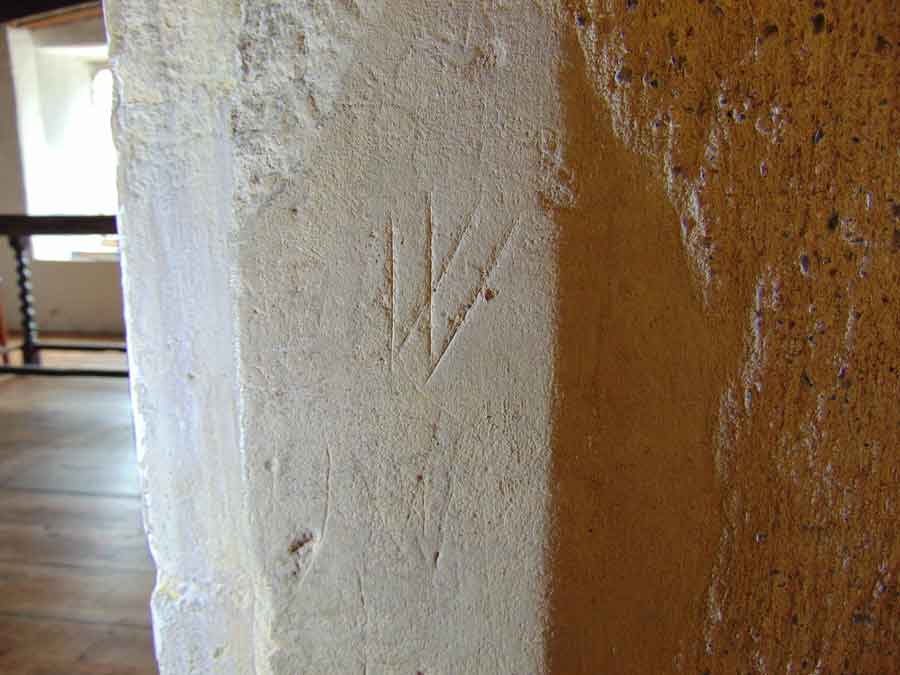
However, and this is where it might just get a tad confusing, some masons used as their marks symbols that have become associated with apotropaic functions, or ritual protection marks; in particular here I am talking about the VV symbol and the pentangle. Yes, these marks are undoubtedly ritual protection marks - but they are also used as mason's marks. Just because you find a structure covered in pentangles or VV marks doesn't necessarily mean they are witch marks. It is a little more subtle than that. A little more nuanced. If they are repeated throughout a structure, as at churches like Loddon in Norfolk, and if they are chisel cut in a neat and precise manner - then they are MASON'S MARKS. Now here's the thing, just to really annoy you, it is worth bearing in mind that the masons may have chosen those particular marks simply because of their recognised protective function...

And then there are the third type of mason's mark - those created by the Master Mason.... but I think I'll leave that for another time...

So, when looking at/for mason's marks here are a few simple rules to bear in mind...

Rule 1 - if it isn't cut with a chisel it isn't a mason's mark. Simples.

Rule 2 - just because you see the same mark on two different buildings does NOT necessarily mean they are the mark of the same mason.

Rule 3 - just because it looks like a witch mark doesn't mean that it can't be a mason's mark.

Rule 4 - all the above rules are subject to variation and change without written notice (please see Terms and Conditions)


Wednesday, 1 June 2016

Tea, cake and graffiti - National Volunteer Week

This week is National Volunteer Week - just in case it may have escaped your notice. Just in case you've had your head stuck down a dark hole or something. Just in case you are just emerging from rehab for the seventh time - that sort of thing. National Volunteer Week - seven days in which to sing the praises of volunteers from all walks of life, undertaking voluntary roles within all sorts of organisations. Over 21,000,000 people volunteer in the UK each year, contributing an estimated £23.9bn to the economy - so we aren't talking small beer here. To put it into perspective, if all the UK' volunteers were members of a single organisation, it would be the largest organisation in the country. So massive is volunteering in the UK that this year Volunteer's Week actually runs from the 1st to the 12th of June.... although they might want to look at the name... just saying...

A week such as this is particularly relevant to anyone who works within the heritage field at the moment, and even more so within the field of community archaeology. You see, the things is, without the input and help from any number of amazing volunteers, most community archaeology simply wouldn't happen. It couldn't. Without the thousands of hours these amazing people put in to doing something that they love these projects just could not take place. Take the graffiti surveys for example. With over 1150 surviving medieval churches in Norfolk and Suffolk alone - and a couple of cathedrals - any attempt at fully surveying them all with any degree of thoroughness would take an individual many, many years to do. If undertaken by a commercial organisation it would cost tens of millions of pounds - at a time when that sort of money is barely available to even keep the buildings water-tight. The only way in which to carry out surveys on this scale has been with a fantastic band of loyal, and slightly barmy, volunteers.


And what volunteers they have become! Take for example the Norwich cathedral survey volunteers. They began, as I'm sure they won't mind me saying, as a rather disparate bunch. A few had some archaeological or historical experience, but most came to the idea of undertaking a detailed building survey as something entirely new. However, in the last four years they have more than risen to the challenge. They have undertaken measured surveys, and drank tea. They have carried out raking light surveys, and eaten cake. They have tried their hands at doing RTI surveys - and laughed, smiled and joked their way through countless Saturday's. They have led tours of the building, spent hundreds of hours talking to the public about medieval graffiti - and have even been involved with training the cathedral guides. And whilst they were doing all this, whilst they were busy enjoying themselves and educating others, they have become some of the very best graffiti surveyors I have ever come across. I have no reservations in stating that they are now far better than many of their commercial counterparts - and much more fun to be with.


The thing is, much as we value our volunteers, and simply couldn't get along without them, we simply aren't very good at working with them all the time - and it's quite likely that they won't be around too much longer anyway. 

In community archaeology in general it is worth remembering that those people leading the projects - myself included - are first and foremost archaeologists. We aren't volunteer managers, have usually only received the barest training in working with volunteers, and have generally had to make much of it up as we went along. Occasionally we get it wrong - but hopefully learn from the experience. It shouldn't be this way - but it is. However, if we want to continue operating these sorts of projects into the future then that really, really has to change - because volunteering is going to change - and that change is coming very soon...

At the moment there are many, many projects being undertaken in the UK that completely rely upon volunteer input - the medieval graffiti surveys being just a single example. There are also some pretty major heritage organisations, in particular charities like the National Trust and many major museums, whose own business models - essentially their ability to function - is based upon being able to access a large number of volunteers each and every day. Without volunteer input these organisations just couldn't carry on doing what they are doing in the way they are doing it. Only a few weeks ago I was a small part of a much larger team of archaeologists who spent an entire week training National Trust volunteers many different aspects of archaeological fieldwork. During the week the volunteers learnt everything from undertaking a geophysical survey and standing buildings recording, to graffiti surveying and landscape history. By the end of the week the individuals were volunteering for additional archaeological activities - and were already taking an active part in one of the National Trust's largest ever archaeological projects. The problem, of course, is that this level of volunteering quite simply won't be available in the future. There will, unquestionably, be a far reduced number of volunteers available - and they'll be very different volunteers than the ones that so many projects rely upon these days.


The problem is pretty straightforward really - age and economics. As the individuals who currently volunteer get older, but largely remain fit and active (quite possibly in part due to their volunteer activities), they'll want to continue volunteering. And why shouldn't they? They offer a wealth of experience and knowledge that any organisation would be just plain daft to turn down. However, whilst there are only one or two things that volunteers in the 55-70 age group can't currently do, as they get older there will be increasing physical limitations. Certain activities are going to get more difficult or problematic. As a result the volunteer activities they undertake will have to change - and the business models will have to change with them. Now this wouldn't be much of a problem if there were a new generation of volunteers appearing to undertake those tasks once carried out by the older volunteers - but it simply isn't going to happen. The time when people could retire at sixty-five, sixty, or even as young as fifty-five, is soon to be long gone. As life expectancy increases so will the average retirement age, with recent studies suggesting that retirement at seventy could be the new norm by as soon as 2030. What that means is that for those people currently in the forty to fifty-five age group retirement may simply never happen. They'll be too busy working to volunteer for anything.

The end result of this is that many, many organisations - from the National Trust and major museums, all the way down to local community archaeology groups - are going to have to start seriously addressing the issue of future volunteering. In the first instance we are all going to have to make much, much better use of the precious and finite resource that volunteers represent. Large scale volunteer led projects, such as the county graffiti surveys, may have a limited shelf life. If they aren't completed in the next decade or so then it is quite likely that they will never be completed by volunteers at all. For organisations such as the National Trust and many museums the challenges may in fact be far greater - and more long term. They are going to have to fundamentally rethink how they operate. So I suppose the lesson is, in this week where we celebrate all our amazing volunteers, let's make them really understand just how special they really are. We need them more than they need us - and that is going to become increasingly clearer as each year passes...


So - Colin, Pat, Tony, Mark, Jess, Lesley, Paul, Claire, Terry, Ann, Clare, Brian, Hugh, Kathleen, Bev, Sarah, Chris, Simon, Frances, Joy, Louise, Jenny, Robert, David, Mike, Mike, Mike, Mike - and all the other Mike's, Kett's rebels and the wonderful tea-drinkers - thank you for ALL of the hard work, the friendship and the support. NONE of this would have happened without you.


Wednesday, 6 April 2016

The 'magic of an old house: giving up our secrets...

The house was old. Older than almost every other house in the village, and almost as old, some said, as the village itself. It was built at a time out of mind, when England was too busy tearing itself apart in the bloody dynastic conflict known as the Wars of the Roses to worry about recording the building of a single humble house. By the time the Tudors came to the throne the house was already mature, had already been expanded beyond its early medieval origins, and grew even further as the bloated mass of Henry VIII dissolved the nearby monastery - giving locals free access to hard found, hard fought for, dressed stone in an area devoid of anything harder than clay lump. Monastery stone was built into a gable end. Narrow stone windows, that once lit a small monastic room where men dedicated their prayers and lives to God, now lit the brick spiral staircase to the second floor. Carved remnants of angels peered from dark corners, and fractured stone arches sat lopsided and irregular alongside neat Tudor doorways.

As more time passed the house grew again. The ravages of the Civil War passed by these windows, newly inserted into the medieval walls, and the great fireplace was in-filled and reduced in size as a new kitchen was built onto the southern face of the ancient stones. Puritans worked this land and left their marks, austere and unadorned, upon the house they lived in, casting baleful glances at the weathered stone angels of a superstitious past. With the coming of the Age of Reason in the eighteenth century, reason dictated that the house became larger still, with a dairy built on to the eastern end, and then extended upwards to form mean rooms for the farm servants. And so time passed, and the ancient house grew. No fixed pattern to the expansion, and no great overall design - just the piecemeal additions of generation after generation, as needs, finances and fashion dictated. What began as a simple pair of late medieval rooms, butted up against a chimney of monumental proportions, grew to become a great tumbling of floors, stairs, doors and rooms that made up a substantial Norfolk farmhouse.

It was, and is, an ancient Norfolk house much like any other. A house that held innumerable joys and countless tragedies. A house that had seen the coming of new life into this world, and the loneliness of a myriad deaths. A house of so many pleasures across half a dozen centuries, and where salt tears had stained the old plaster with despair and hopelessness. An ancient house, with an ancient history, sitting like a lead weight upon the rubber sheet of history. Drinking in each new experience, feeding itself upon the emotions of the lives that passed within its walls. Soaking up the human spirit until every timber, every brick, every pane of leaded glass, hummed with the resonance of the past.

This is the house in which I grew up.

This was my home until my very late teens, and it was, as you will probably already be thinking, a privileged upbringing. Yes, I did have a brick spiral staircase that led to my bedroom. Yes I even had the odd arrow-slit from which I could view the straggling remains of a badly placed north-facing rose garden. Yes, there were vintage cars and boats. And barns and fields in which to have a crafty smoke, or an illicit snog with a girl from the village. It was, undeniably, privileged. And yet, my own childhood, just like the hundreds of others that passed between those old walls, also had its share of the mind numbing realities that the world forces upon us. There were the arguments, the fights, the dread horror of insecurities, and the dark patch of drying blood on tarmac and a white picket fence that will live in my nightmares forever. The old house took it all into itself; fed from the love and from the pain, and will still stand long after I am gone - a silent sentinel of the past.


And this is the house where I first came across the concept of magic; an inbred and ingrained understanding that undoubtedly led me to the strange place in which I find myself today. The magic was not one of spells and witches, although there was still talk in the village of 'certain' families even those few decades ago when I grew up. This wasn't the magic of the text books, or of the bodice ripping historical novella. No, this was the gentle magic of the house itself. This was the magic of concealed objects, ritual protection marks, taper burns and 'lucky' coins secreted in the cracks of dark aged oak.

Now to disabuse you concerning my childhood home and upbringing. Yes, as I said, it was a privileged upbringing, but most certainly not one born of wealth. When my parents bought 'the house' it was a wreck; the result of generations of agricultural decline and before the birth of farm subsidies. It was run down to say the least. It had plumbing - just - but luxuries such as heating had never deigned to cross its threshold. Half of the house was actually derelict, and if you stood downstairs in the dairy, and looked upwards, you could see the stars. A few months after we moved in the main stairs collapsed, and there were whole areas upstairs where we weren't allowed to enter for fear of falling through the floor boards. The previous owners, showing unusually prescient good sense, had moved into a snug bungalow they'd built on the former tennis courts, leaving us to renovate the rambling wreck that was 'The Grange'. However, despite the ice on the bed clothes in the morning, the mice in the attics, and the general fear of falling through the floor, the ramshackled state of the house meant that we all got to know it intimately. We learned its secrets piece by piece, as layer by layer the artifice was stripped back and the bare bones of the past were revealed. Gradually, slowly, the house began to give up its secrets, to give up its magic.

The easiest to spot were the coins. If the light was in the right direction you could just see the dull coppery glow of them, pushed deep into cracks in the massive oak timbers of the ceilings and roof. As children we spent hours prizing them out of their dark and secret places, only to stare at the worn and faded heads of long-dead kings and queens. Some had been sealed in with candle wax or tallow, which made them all the brighter to young eyes when finally they succumbed to the digging of a persistent pen-knife. My grandfather told us these were 'for luck', and so that the house would never fall upon coin-less times - and each was carefully placed back where we had found them, wax rubbed smooth again with a grubby thumb to seal them in. Then there were the 'witch marks'; the strange motifs and symbols etched and burnt into the massive beam that ran across the fireplace. The beam itself was more of a tree-trunk, squared off and running over fourteen feet from side to side, that belonged to the oldest core of the ancient house. Here were to be seen conjoined 'V' markings and compass drawn symbols, initials and dates lying alongside, and often over the top. Some were gouged deep into the wood, whilst others were mere scratches that could only be seen in the right light. Symbols older than the house itself, and there to ward off evil, and keep the occupants safe from harm. Alongside these were the taper burn markings, ancient scorches in ancient timber, designed to protect the house from fire or lightning strike. Some were merely light burn marks, that could be argued away as a mishap with candle or hot poker, whilst others were so deep as to only possibly be the result of multiple and deliberate re-burning of the mark. A history of protection and folk belief in one aged beam.

And then of course, as renovation dug deeper into the history of the house, and stripped back each layer and century, there was the great fireplace itself. When we arrived the great chimney breast boasted a small tiled 1930s fire surround and grate, looking tiny and unloved beneath a massive timber bressumer. My father and a friend determined to remove the modern replacement and 'open up' the great fireplace beneath. This they did, amidst clouds of soot and swearing, only to reveal another slightly larger fireplace behind the first. This then followed the path of the first fireplace, revealing yet another fireplace beneath... the Russian doll of Norfolk's architectural history. In all there were no less than six fireplaces all sitting inside the original, and seventh, great fireplace - and between the sixth and seventh fireplace it sat. A shoe, or more correctly an over-shoe or patten, dating back to the late sixteenth or early seventeenth century. Put there centuries before, by long-dead people who had lived in the self-same house as we did, to try and ensure that no harm befell them or their loved ones.

For years that patten sat on my desk as I did (or failed to do) my homework. I would stare at its minute stitching and beautiful curved wood, wondering who had worn it, and what had become of its twin. It was a talisman in difficult times, when my own family added to the losses and despair that the ancient house had seen. It was a charm in its own right, steering me towards the past. To where I am now. It was the magic that comes from an ancient house.


And where is it now? Does it still sit on my desk as I write, guiding me still? Or does it sit somewhere in a dusty museum store-room? Of course not. Just before I left that house forever, and put behind me the secrets of my teenage years, the patten was returned back into the care of the house itself. It was hidden. Somewhere secret. Somewhere safe.

Wednesday, 30 March 2016

Six years of hunting demons...

Today marks a bit of an anniversary - a boundary - a turning point. As of today I have 'officially' been studying medieval graffiti for six years. Six long, cold years of crawling around churches staring at the walls. Six long years of immersing myself in the history of our churches and people. Six long years of wondering why I don't have a 'proper' job. And so, after over half a decade it is time to take stock; time to add a little perspective, and time to assess what I have really achieved.

Well I can certainly say it has been an eventful six years. I've been part of a project or two that has made some amazing discoveries. Found secrets that were thought long-forgotten etched into the walls. Chased demons across the stonework, and traced medieval curses with my fingertips across the plaster. I have come to intimately know centuries-long-dead master masons, who left nothing in this world but the carved stones that lie beneath my hands, and touched the last and only markings made by the damned souls of heresy. I have found and recorded desperate messages of plague and despair, and messages of love and hope. All there, on the walls, waiting in the dark for centuries.

And I have come across some amazing people, both the living and the dead. The fantastic volunteers, friends and helpers who have, so to speak, shared the journey. I've met some real looneys too - complete and utter nutters - many of whom also fall quite happily into the 'friends and helpers' category - the others who are hopelessly still out there searching for Templar graffiti. I've also been very lucky. The projects have won a number of awards. Big shiny national awards. I've no idea where they are now obviously, as I 'think' I gave them to the volunteers, but it was gratifying to see all their hard work paid back, even in such a small way. And then there was 'The Book'. A bit of a surprise all round - being asked to write it being one of the most obvious - and then people actually paying good money to actually buy it. Oh, and the media stuff. That was all quite good fun too - even the stuff in the Daily Fail - as long as you never, ever, ever read the comments section obviously. And there was cake... lots and lots of cake. So, all in all, it has been quite a six years. An adventure in archaeology - and baking.

However, after six years it is time to question whether we actually achieved anything that we set out to achieve? Whether any of the questions concerning medieval graffiti and the people who made it, that we posed six years ago, have actually been answered. Are we really any closer to understanding just what is really happening on the walls? Or are we, like all those who came before us, just staring at the walls in the dark? Are we just fumbling amongst the hard stones looking for meaning? Well, we have certainly answered some questions, and made some quite startling observations.

In the first place, and probably most significantly, we now understand just how common medieval graffiti actually is. We knew when we began that there were a lot of examples out there, but the sheer quantity of inscriptions has been one of the most staggering aspects of the projects. In Norfolk alone we have recorded over 30,000 individual inscriptions, with an additional 5000+ in Norwich cathedral. Suffolk has produced almost as many, and images arrive daily of medieval graffiti from all over the country. New surveys are springing up as well, with almost half of southern England now involved, and organisations such as Historic England are now attempting to issue guidelines on how a graffiti survey should be undertaken. We are, in effect, looking at a whole new area of research.

But have we answered any of the questions that we set out to examine?

Possibly, and possibly not. What I am clear on is that we have certainly generated one hell of a lot MORE questions. Things that would never have occurred to me, or probably anyone else for that matter, when we first began staring at the stones all those years ago. New questions that have pushed themselves forward as the masses of data piles up, and they are questions that, to be honest, we are going to need a lot more data to answer. In many cases we have answered the who, when and how? We have traced individuals across the stonework and vellum, charted their births, marriages and ultimate demise. We have recorded their marks on the walls, and tried to find their marks on this world. We have traced long dead rectors who recorded their own charitable works. We have recorded the militia musters that no other record shows as ever having happened. We have traced the tragedy of seemingly insignificant deaths; so significant to those around them, those who loved them, that they etched the very stones themselves. These questions we have answered. And yet, the bigger questions remain. The questions that bother me. The questions I ask in my head in the dark hours of the night. The question of Why?


This then is perhaps our task for the next six years. To go beyond the treasure hunting and gathering of individual marks on the wall. To understand not just the who, when and how - but also add a little flesh to those cold stone bones... there will undoubtedly be demons along the way...

Tuesday, 27 October 2015

Agincourt: a 600 year old myth?

In the tiny and well kept church of St Mary at Barnham in Sussex is an intriguing little piece of ancient graffiti. Protected today behind perspex, and difficult to read, local tradition states that the Latin text asks for the reader to 'pray for the soul of my father who died at Agincourt'. Is this then a direct link between an individual and a medieval battle that has come to be regarded as iconic? Does this tiny inscription actually refer to a real person? A warrior that fought through the mud, blood and terror of that damp October day alongside an English king? Or is it perhaps just one more myth to be added to the already long list of such myths that surround this much written of little war? If it is, then it's in good company - for even today, six long centuries after armour clad warriors tore each other to pieces in a muddy field, the whole event is almost more myth than reality - and one of the greatest of those myths still survives, often repeated and never questioned, right through to the present day.

The significance of the battle of Agincourt goes far beyond medieval military history, and far beyond what was actually only a moderately successful armed incursion into the realm of France by a belligerent young English monarch. It was undoubtedly a logistically great, and unexpected, victory for the outnumbered English, and saw the pitiless deaths of a large number of the French nobility. But really? Does that make it worthy of all the fuss and jingoistic nonsense that has been poured forth from the national media in the last few week? I think not. No, the real reason that Agincourt has become so significant to the people of this damp and verdant island is simply because it is how the English like to see themselves. Agincourt has become more significant in the last two and a half centuries than it ever was during the Middle Ages, for the very simple reason that it embodies an 'idea', perhaps even an 'ideal', of Englishness. The idea of the underdog, taking on a massive and overbearing enemy and, against all odds, coming out victorious. It is the story of 'the few' against the many - and no coincidence that the Laurence Olivier version of Shakespeare's Henry V was actually made during the height of the Second World War - a time when mention of 'the few' would awaken sharp echoes of very recent events that took place in the skies above southern England. As Jeremy Paxman of all people has written, the phrase 'We few, we happy few, we band of brothers', has become "the rallying cry of the English idea of heroism".

Agincourt has become the democratic battle in the eyes of the English. When proud and humbly born yeomen brought down the might of the French aristocracy with their peasant weapons. It was a battle won by massed flights of feather fletched arrows piercing the elegant plate-armour of the nobility. It is the battle where the common men of England, against all the odds, stood their ground and overturned the accepted order of the day. Where noble birth would not save you, whatever your rank, from the mud and the blood.
And that is largely the problem with Agincourt both as a battle and a symbol of English 'pluck' - yes I said 'pluck' - in that the story has now become far more powerful than the reality. The images and ideas have become more potent than the truth. The myths have become the story that the good man teaches his son, and any attempt to dispel such myths is actually met with hostility.  A knee-jerk reaction that sees such questioning of accepted 'fact' as simply un-English, un-patriotic and verging on the sort of thing only 'johnny-foreigner' would do! The reaction, even of some historians, to someone questioning the essential truths of the Agincourt myth would put even the outrage of a member of the English Defence League being given a gift voucher for a Burka wholesalers to shame. You simply don't do it.

The problem of course is that much of the story that has been pedalled out these last few weeks is simply that - a story. A myth that has grown up around the cinema and writers of nineteenth century epic novels for ambitious, Empire bound, schoolboys. You see, the traditional story of the 'great victory' of Agincourt is largely based on misinformation and misconception. It may well be a story that chimes well with our view of ourselves, but we must recognise that even great stories sometimes need examining again in the light of new, or even old, information. Okay, I'm not going to suggest here that the English didn't win the battle or something similar. I'm unlikely to accuse Henry V of 'war crimes' either (as a recent French interpretation did). All I'm suggesting is that our recent image of the battle, of the plucky English archers, picking off the French knights with their longbows, is largely a fiction. Simply didn't happen. Actually couldn't happen. It's a myth.

You see, there is rather a fundamental problem with the traditional story of the battle of Agincourt - and when I say 'traditional' I mean of course that portrayed by Hollywood, and most likely the image you have in your head - in that the English longbow, the English archer and the English cloth-yard arrow, could NOT penetrate the high quality plate armour worn by the majority of French men at arms that day. It simply couldn't do it. Not a hope. The image of the massed volleys of arrows turning the sky black and bringing down wave after wave of French knights simply couldn't have happened the way most people think it did. The "thud of bodkin arrowheads striking through plate-metal armour and tearing into flesh" didn't happen either. Sorry! And it is, I think you will agree, a rather fundamental problem with regards to our interpretation and image of the battle.

Now at this point I should rather make a confession. Never something I'm totally happy to do obviously. You see, the thing is, long before graffiti got it's claws into me, I wrote my MA thesis on the military decline of the longbow. I also, for my sins, wrote almost a whole page of the Mary Rose catalogue, and spent a lot of time looking at late medieval and Tudor archery. Perhaps more importantly, I am an archer myself. I have been since I was eight years old, and have used a longbow for over a quarter of a century, and in my twenties regularly shot a war-bow several times a week. I know longbows, I know what they can do, and as such this rather major flaw in the whole Agincourt debate didn't pass me by.

Now I am by no means the first person to have noted this rather fundamental flaw in the Agincourt story. Not by a long way. There has been a rather vocal argument between a number of historians over the last few decades arguing exactly this point. On the one side some have stated that the 'science' rather supports the view that arrows from a medieval longbow cannot penetrate good quality plate armour. One the other side historians have argued that frankly, the science is doing it all wrong, and that the historical accounts must be correct. It's an argument that has, at times, seemed bloodier than the battle itself. So what of the science I hear you ask? Well, it's simply really. Ever since this 'problem' was first noted, way back in the nineteenth century, people have been conducting tests to see exactly what an arrow from a longbow could penetrate. Most of the early tests, which were admittedly pretty unscientific, came to the conclusion that the arrows simply couldn't do the job. However, with every set of tests that came back negative there were always those whose answer was that the tests themselves were faulty - and that the wrong type of bow had been used, or the wrong type of arrow - or even the wrong type of armour. New tests were needed.

Finally, only in very recent years, were a new set of tests were undertaken. The arrows and bows were modelled exactly on those found aboard the Tudor warship 'Mary Rose', the armour was of exactly the same metallurgy as examples from the period, and the tests were undertaken in scientific conditions at a defence research laboratory. Much to the delight of those historians who favoured the traditional view of the battle - the arrows were found to pierce plate armour! However, closer examination of the results showed that the arrows certainly could pierce plate armour - but only if shot from almost point blank range, striking the armour at a particular angle - and then only piercing it to a depth of about an inch. Bearing in mind that armour was worn over a heavily padded 'arming doublet', it's safe to say a more damaging wound could probably be inflicted with my desk stapler. So how then had this come to pass? How could historians have got it all so very wrong for such a long time? How could all the written accounts just be so incorrect? Well, the truth is that neither the contemporary accounts, or the historians, had all managed to get it wrong.

Believe it or not the battle of Agincourt is one of the best described late medieval battles to have taken place in western Europe. The stunning and unexpected outcome of the battle, and the fact that so many members of the nobility perished that day, made it a popular subject for contemporary historians and chroniclers. As a result we have quite literally dozens of contemporary and near contemporary accounts of the conflict - all of which have been brought together most usefully by Dr Anne Curry in her wonderful volume 'The Battle of Agincourt: Sources and interpretations'. They range from eye-witness accounts of the slaughter itself, to historical monographs written a decade later and detailing the battle as God's vengeance upon the unworthy French. However, whilst the sources may be varied, they all tend to agree on one thing. The English archers that day did great slaughter - but that the slaughter was not done with arrows. The accounts talk of the English archers 'wounding' French knights with arrows, and most certainly killing, maiming and wounding the horses of the French cavalry attack, but not of the massed volleys of arrows plunging French knights into the mud - as so beloved of film-makers everywhere. The slaughter from the English archers came in a different manner. It came with the swords, the axes, the knives and the clubs - searching out into the mud, amongst the screaming and dying horses, to put an end to men clambering to their feet amongst the blood and horse shit. It was the savagery of daggers thrust into armoured joints, of axes chopping down onto exposed flesh, and leaden clubs beating in the steel helmets until all movement ceased. It was, put simply, butcher's work. Mud splattered steel and once bright embroidery ripped from the mangled bodies that choked in the filth and their own life blood. A great English victory, hard won from an overwhelming force, that perhaps saw the very best of medieval England; but most certainly its worst.

And so endeth the myth. Ah, but myths don't die that easily. You see, despite a rearguard action by a few well meaning but misguided historians, we've rather known all this for quite a while. Anyone reading any of Anne Curry's books on the subject will note that she steers very well clear of discussing the actual power of a longbow. About what it can actually do. The trouble is that nobody really wants to be the person that turns around and says that, all that stuff you thought you knew, is utter rubbish. It won't go down too well. Certainly won't get you invited to too many dinner parties, that much is certain. Not twice anyway.

So where then does this leave the myth of the battle of Agincourt? What reality or truth must we consider when viewing that long distant conflict? Does it change anything? Which story should the good man teach his son? 

Well, I for one think there is a clear answer, and it is that we should never accept a 'given' history. That we should always question that which is placed before us as accepted 'truth'; particularly where patriotism and jingoistic rhetoric play a part. History is indeed written by the victors - military history doubly so. This perhaps is more pertinent to graffiti studies than you might think. With so little written upon the subject, what has been written tends to be accepted as the truth. It shouldn't be so. As with all history, new evidence leads to new interpretations, and we should always be open to looking at them with as open a mind as possible. And as for the Agincourt graffiti in Barnham church - well perhaps we'll leave some myths and stories to endure just a little while longer...


Tuesday, 8 September 2015

Understanding medieval graffiti: Long lost souls peering over your shoulder...

So I'm here. Sitting in a church again. Staring at the dark monochrome of the walls, all whitewash and dark stained stonework. Above me I can hear the rain, a gentle persistent hiss against the lead of the roof. Even the bright glass of the windows is dull and opaque, longing for the kiss of sunlight. The wall is in front of me. It's always in front of me - stones bonded by the sweat of men and time. Just me and the wall. And so, as one does with an old friend and an even older adversary - I simply stare - looking for a way in. Washing light across the surface, watching it illuminate the darkness of centuries, bring to dancing life the figure of the demon to my left. Another sweep of the light across the cold stone. An intricate design of latticed circles leaps from the wall, design to trap the evil from a time now lost to memory. Time out of mind. Then there are the letters, degraded, worn and near indecipherable - a prayer for health by a soul whose bones have long ago wasted to dust? The light finds them all - and yet still I look for a way in. A way past the markings. A way past the scratching on the wall. A way that no light, no matter how strong, can light a path to; a way into the medieval mind.

The rain is harder outside now and faint drums echo above me. In a dark corner of the church an intermittent and all but silent splash on flagstones; a place where water, rot and time have finally found their way in. Above me fragments of paint peeling angels now weep real tears. Their bright colours temporarily restored for a few splendid, damp, hours - before they fade again even further into the past. And yet there is nobody here to see their glory but me. Me and the figures dancing in the light on the wall - and, I fear, I understand the demons on the stones far better sometimes than the angels on high. The demons on the walls are my friends. They are my way in. They are the key to understanding.

It isn't enough to simply record what we find on the walls. It is a start. No more than that. The key though has to be understanding what we are seeing. To try and find our way into the mindset and motivations of the long-dead who left these tantalising messages for the future. Without understanding we are no more than collectors of images; seekers of historical butterflies that we happily send to the gas jar and pin to a trophy board. Without attempting to understand what we find we are drawing out the life, the humanity, of every single simple marking. Hunting treasure for the sake of the treasure. Creators of catalogues. No more. What can we truly understand and learn from the name John Abthorpe carved into the tower arch of Troston church unless we know that he was the last of his line; a childless lordling whose name would die as his flesh corrupted.  What can we understand of the plaintive inscription in the chancel at Acle unless we understand that it was made during an outbreak of the plague; a time when the very fabric of the world became unraveled and desperation brought painted demons into the church?


And so we must, if we are to understand what we see, find a way in. Find a way to worm ourselves between the stones. To understand the mind that leaves fear and demons on the wall. I wonder myself, as I sit in the darkness listening to the rain, whether archaeology alone has the key. Can a profession that thinks in terms of a 'juvenile interment' rather than 'child burial' really understand what it means to discover the mortal remains of a once beloved son or daughter? Can those who strive to be seen as scientists, echoing the words of textbooks, really understand the humanity in what they view? I am, I know, being too harsh. Some of the very best archaeologists are those who have always let the humanity show through their work. Have always remained ultimately human. And yet, after the long years staring at the walls, the way in lies elsewhere. 

To understand what we find and record we must understand, or at least try to understand, the motivations of those who created these marks. These scratches in the stone. We must look at their church of incense and bright colours rather than the drab monochrome of today. We must hunt through the borders of their manuscripts, chasing the tails of grotesques and jousting snails. We must listen to their words and their music; try to understand the chant, the melody and the dance of medieval life. We must see the splendour and embrace the squalor - and feel the lost souls peering over our shoulders as bright light washes across the stones. To do any less simply leaves us sitting in the dark, listening to the rain...